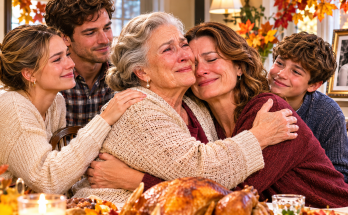
Chapter One: An Invitation Twelve Years Too Late
The telephone rang on a Tuesday morning, nine days before Thanksgiving.
When I saw my brother’s name on the screen, I assumed somebody had died.
Richard hadn’t called me in nearly twelve years.
Not on my birthdays.
Not during Christmas.
Not even when I underwent surgery following a serious automobile accident.
Yet there was his name, appearing on my telephone as though we had spoken only yesterday.
“Hello, Richard.”
“Elizabeth! How’s my favorite sister?”
I nearly laughed.
I was his only sister.
“I’m doing well.”
“Wonderful. Absolutely wonderful. Listen, we’ve been discussing Thanksgiving, and everyone agrees it’s time we brought the family together again.”
I placed my coffee cup on the kitchen counter.
“Everyone?”
“Of course. Mother, the children, Aunt Helen. We’ve all missed you terribly.”
For a moment, I wondered whether he had dialed the wrong number.
Our mother had forgotten my seventieth birthday two months earlier.
Richard’s children hadn’t acknowledged my existence in years.
And Aunt Helen had once informed me that attending family gatherings was a privilege I shouldn’t expect after embarrassing everyone with my financial circumstances.
Now, apparently, they had missed me terribly.
“How thoughtful,” I replied.
Richard continued enthusiastically.
“We’re having dinner at Mother’s house. Nothing extravagant, just family. We’d love for you to come.”
I looked through the kitchen window toward my little garden.
“What changed, Richard?”
There was a brief silence.
“What do you mean?”
“Twelve years is a rather long time.”
He laughed nervously.
“Life gets busy, Elizabeth. You know how it is.”
I knew precisely how it was.
I knew what it meant to sit alone on Christmas morning while photographs of family celebrations appeared online.
I knew what it meant to discover that my nephew had married without inviting me.
And I knew what it meant to hear my own mother describe me as a disappointment.
But I also knew something Richard didn’t realize I knew.
Three days earlier, my uncle’s attorney had contacted several members of our extended family concerning the administration of his estate.
My uncle, George Whitman, had passed away at eighty-seven.
He had never married or had children.
He had also accumulated considerable wealth through decades of commercial property investments.
According to preliminary estimates, his estate was worth approximately $12 million.
Richard had apparently heard about it.
And suddenly, he remembered my telephone number.
“What time is dinner?” I asked.
“Three o’clock. Does that mean you’re coming?”
“Yes.”
His excitement was unmistakable.
“That’s wonderful! Mother will be delighted.”
After we disconnected, I sat quietly for several moments.
Then I walked into my study, opened the bottom drawer of my desk, and removed a cream-colored envelope.
My uncle’s handwriting appeared across the front.
Elizabeth — When the family finally comes calling.
I smiled sadly.
Uncle George had understood our family considerably better than I had given him credit for.
Chapter Two: The Daughter Who Disappointed Everyone
My name is Elizabeth Whitman.
I was seventy years old, a retired librarian, and a widow of fourteen years.
For most of my life, I had occupied an uncomfortable position within my family.
Richard was the successful son.
I was the daughter who had chosen an ordinary life.
Our father owned a prosperous accounting firm outside Hartford, Connecticut. Our mother, Margaret, took considerable pride in our family’s reputation.
Richard attended an expensive university, earned a business degree, and eventually established his own financial consulting company.
I studied literature and became a librarian.
My mother considered that decision disappointing.
“You could have accomplished so much more,” she frequently reminded me.
I never understood why helping children discover books, assisting elderly people with research, and maintaining a welcoming community space counted as accomplishing so little.
When I married Thomas, a public-school history teacher, my mother’s disappointment deepened.
“He’s a lovely man,” she admitted. “But lovely men don’t necessarily provide comfortable lives.”
Thomas and I purchased a modest house.
We drove secondhand cars, took inexpensive vacations, and saved carefully.
We were never wealthy.
But we were happy.
Thomas possessed a remarkable ability to make ordinary days feel special.
He brought flowers home from the grocery store.
He wrote little notes and slipped them into my lunch bag.
Every Saturday morning, he made pancakes while listening to old jazz records.
We had hoped to have children, but life didn’t unfold that way.
Instead, we devoted ourselves to our students, our neighbors, and each other.
When Thomas developed cancer, I reduced my working hours to care for him.
The medical expenses gradually consumed much of our savings.
After his death in 2012, I found myself facing considerable financial uncertainty.
I asked Richard whether he could recommend someone trustworthy to help me review my finances.
He misunderstood my request.
“Elizabeth, I can’t start supporting you financially.”
“I haven’t asked you for money.”
“Good. Because I have responsibilities of my own.”
My mother was equally unsympathetic.
“You should have married someone with better financial prospects.”
I stared at her in disbelief.
Thomas had been dead for less than three months.
That was all she could think to say.
I returned home and cried beside his empty chair.
Yet somehow, those words marked the beginning of a different understanding.
I could spend the rest of my life trying to earn my family’s approval.
Or I could accept that their definition of success had never reflected what mattered to me.
I chose the latter.
Unfortunately, my family interpreted my independence as resentment.
The invitations gradually stopped.
And before long, I became little more than a name they occasionally mentioned when discussing relatives who had made unfortunate choices.
Chapter Three: The Man Who Never Forgot Me
There was one exception.
Uncle George.
My father’s younger brother had always been different from the rest of the Whitman family.
He was wealthy, but he disliked extravagance.
He wore old sweaters, drove the same station wagon for nearly twenty years, and insisted that coffee tasted better from a chipped ceramic mug than from expensive porcelain.
He rarely attended the formal gatherings my mother organized.
“Too much conversation about people who aren’t in the room,” he once explained.
After Thomas died, George began visiting me regularly.
Sometimes he brought groceries.
Sometimes he arrived with a newspaper and stayed for coffee.
He never treated me as someone who needed rescuing.
He simply provided company.
One afternoon, he found me repairing a bookshelf Thomas had built.
“Your husband was a good man,” he said.
I smiled.
“He certainly was.”
“Your mother never understood him.”
I looked up.
“No.”
“That’s her loss.”
George helped me finish repairing the shelf.
Then we sat together on the porch until sunset.
As the years passed, our friendship deepened.
I drove him to medical appointments when he stopped driving long distances.
I helped organize his paperwork when his eyesight began deteriorating.
When he underwent knee surgery, I brought homemade meals and helped him arrange appropriate assistance during his recovery.
He occasionally offered to pay me.
I always refused.
“I’m your niece, George. Not your employee.”
He laughed.
“I suppose that’s true.”
Richard rarely visited him.
Neither did my mother.
Their excuses were predictable.
Business commitments.
Travel arrangements.
Children’s activities.
Busy schedules.
Yet whenever George’s birthday approached, they sent expensive gifts accompanied by sentimental cards.
He usually placed the unopened gifts in his guest bedroom.
“Interesting people,” he once remarked.
“Who?”
“Relatives who can remember your birthday but can’t remember to ask whether you’re lonely.”
I understood exactly what he meant.
In his later years, George and I developed a Thanksgiving tradition.
We prepared a small dinner together, invited neighbors who had nowhere else to go, and spent the afternoon telling stories.
He always insisted on washing the dishes.
I always complained that he used too much soap.
Those Thanksgivings became some of my happiest memories.
Neither of us knew how many we had left.
So we appreciated every one.
Chapter Four: His Final Request
By the spring of 2026, George’s health had deteriorated considerably.
He needed more assistance, and his medical team recommended increasing support at home.
With his consent, I helped coordinate visits from qualified caregivers.
I continued bringing meals, reading newspapers aloud, and accompanying him on short walks whenever he felt well enough.
One rainy afternoon, he asked me to sit beside him.
“Elizabeth, have you ever wondered what will happen to my estate?”
I shook my head.
“That’s your business.”
He smiled.
“An unusual answer in this family.”
I laughed softly.
“I’m sure Richard would provide a more enthusiastic response.”
George chuckled.
Then his expression became serious.
“I’ve spent a great deal of time thinking about what money does to people.”
He looked toward the window.
“When you’re young, you believe money will solve your problems. Sometimes it does. But after a certain point, it starts revealing problems you didn’t know existed.”
I waited.
“People become interested in you for reasons that have nothing to do with who you are.”
I understood.
“I’m sorry, George.”
“Don’t be. I’ve had a good life.”
He reached toward the little table beside his chair and removed an envelope.
“I’ve made my arrangements with Samuel Bennett.”
Samuel had been his attorney for more than thirty years.
“Everything has been prepared independently and reviewed carefully,” George continued. “I know what I want.”
He handed me the envelope.
“Keep this somewhere safe.”
I examined the writing across the front.
Elizabeth — When the family finally comes calling.
“What does that mean?”
He smiled faintly.
“You’ll understand.”
“George, you don’t need to leave me anything.”
“I know.”
He squeezed my hand.
“That’s one of the reasons I wanted to.”
I felt tears gathering.
He shook his head.
“None of that now. You’ve still got to listen to me complain about the coffee.”
We laughed.
Several months later, on a quiet Sunday morning, George passed away peacefully while receiving hospice care.
I was beside him.
So was one of his longtime caregivers.
His final words were barely audible.
“Thank you for staying.”
I kissed his forehead.
“Always.”
After his death, I returned to my empty house and placed his envelope inside my desk.
For several weeks, I couldn’t bring myself to open it.
I missed him too much.
Then Samuel contacted me concerning the estate.
And I discovered that George had left behind considerably more than a farewell letter.
Chapter Five: The Rumor of Twelve Million Dollars
Samuel’s office occupied the upper floor of an elegant brick building downtown.
I arrived carrying my handbag and a photograph of George that I intended to give him.
After offering his condolences, Samuel explained that George had established a carefully structured estate plan.
Several assets required administration.
Others were held through trust arrangements.
The preliminary valuation was approximately $12 million, although final values and obligations would need to be established.
I listened quietly.
“George certainly did well for himself.”
Samuel nodded.
“He did.”
Then he placed several documents before me.
“Your uncle appointed you to an important position concerning part of his charitable legacy. He also made specific provisions for your personal benefit.”
Over the next hour, Samuel explained the arrangements.
Some details surprised me.
Others made me cry.
George had remembered conversations we had shared years earlier.
He had remembered my concerns about retirement, my affection for the public library, and my belief that older people deserved dignity regardless of their financial circumstances.
His estate plan reflected those values.
Before leaving, I asked whether other family members would be informed.
“Those entitled to relevant information will receive it through the appropriate procedures,” Samuel explained.
“I understand.”
He hesitated.
“Elizabeth, I should warn you that incomplete information sometimes creates misunderstandings.”
“What sort of misunderstandings?”
“People hear the estimated value of an estate and assume that one particular beneficiary receives everything.”
I smiled sadly.
“In my family, that sounds entirely possible.”
I returned home.
Within forty-eight hours, my telephone began ringing.
First came a message from my nephew, Christopher.
Hi, Aunt Elizabeth! It’s been way too long. We should catch up.
Then my niece, Victoria, contacted me.
Thinking of you. Hope you’re doing well. Let’s get together soon.
My cousin sent flowers.
An aunt who had ignored me for years mailed a handwritten card.
And finally, Richard called to invite me to Thanksgiving.
Nobody mentioned George directly.
Nobody asked how I was coping with his death.
They were simply delighted to rediscover a relative they had forgotten.
I wondered how long it would take before somebody mentioned the money.
The answer arrived the following morning.
Chapter Six: Everybody Had a Dream
Richard called shortly after breakfast.
“Elizabeth, I hope you’re not overwhelmed with everything.”
“With what?”
“You know. George’s affairs.”
There it was.
I looked toward the envelope on my desk.
“His attorney is handling the necessary arrangements.”
“Of course. Of course.”
He cleared his throat.
“Did George leave everything to you?”
I waited a moment.
“Why do you ask?”
“No particular reason. Just curious.”
“Estate matters are private, Richard.”
“Absolutely. I respect that.”
He paused.
“Although we’re family. You know you can trust us.”
I remembered how trustworthy he had been when I asked for financial guidance following Thomas’s death.
“Yes,” I replied. “Family.”
He began discussing his business.
Apparently, he had discovered a remarkable investment opportunity.
The potential returns were excellent.
He simply needed additional capital.
“How much additional capital?” I asked.
“Oh, perhaps eight hundred thousand. Maybe a million.”
I nearly dropped my coffee cup.
“But that’s something we can discuss another time,” he added quickly.
That afternoon, Victoria called.
She told me about a beautiful house she and her husband had been hoping to purchase.
Unfortunately, mortgage requirements had become difficult.
“If only we had help with the down payment,” she sighed.
Christopher described his plans to establish a restaurant.
My cousin mentioned her daughter’s expensive wedding.
Aunt Helen complained about retirement expenses.
Even my mother telephoned.
At ninety-two, she rarely made lengthy calls.
Yet she spoke for nearly forty minutes.
“Elizabeth, I’ve been thinking about how wonderful it would be if we could all spend more time together.”
“That would have been wonderful years ago.”
She ignored the remark.
“You know, your brother has always been very responsible. He’s done so much for this family.”
I said nothing.
“He deserves some security.”
“Doesn’t everyone?”
“Exactly.”
She paused.
“And someone in your circumstances might be in a position to provide that.”
There was no point pretending anymore.
“Mother, are you talking about George’s estate?”
“Well, obviously you’ve been very fortunate.”
I closed my eyes.
Fortunate.
I thought about George’s final weeks.
The difficult appointments.
The nights spent sitting beside him.
The empty chair at Thanksgiving.
And the grief that still followed me through my ordinary days.
To my mother, all of that apparently amounted to good financial fortune.
“I’ll see you on Thursday,” I said.
Then I ended the call.
Chapter Seven: The Photograph on the Mantelpiece
Thanksgiving morning arrived beneath a pale November sky.
I woke early, prepared coffee, and stood in front of the photograph of Thomas on my mantelpiece.
“You wouldn’t believe what’s happening,” I told him.
Then I smiled.
Actually, he probably would have believed it.
Thomas had understood my family from the beginning.
He simply never allowed their opinions to affect the way he treated me.
I wore a navy-blue dress, a cream cardigan, and the pearl earrings he had given me on our twentieth wedding anniversary.
I also prepared a homemade apple pie.
Despite everything, I wasn’t going to arrive empty-handed.
Before leaving, I placed George’s sealed envelope inside my handbag.
My mother’s house stood in an affluent neighborhood where nearly every property possessed beautifully maintained gardens and impressive entrances.
Richard’s expensive car was parked outside.
Victoria and Christopher had already arrived.
Through the windows, I could see autumn decorations and family members moving around the dining room.
For twelve years, I had imagined what it might feel like to return.
Now that I was standing on the porch, I felt strangely calm.
The door opened before I could knock.
Richard stood there smiling.
“Elizabeth!”
He embraced me enthusiastically.
My mother waited in the hallway.
“There you are, darling.”
Darling.
I couldn’t remember the last time she had called me that.
Victoria hurried forward.
“Aunt Elizabeth, you look wonderful!”
Christopher offered to take my coat.
Aunt Helen kissed my cheek.
Everyone seemed delighted.
I handed over the pie and followed Richard into the living room.
The furnishings had changed.
The curtains were new.
Several familiar paintings had been replaced.
But the mantelpiece remained almost exactly as I remembered it.
There were photographs of Richard’s graduation, Victoria’s wedding, Christopher’s school achievements, and various family vacations.
I searched for a photograph of Thomas and me.
There wasn’t one.
Not even an old childhood photograph of Richard and me together.
Twelve years of absence had been remarkably easy for them to accommodate.
Victoria noticed me looking.
“We’ve been meaning to update the family pictures.”
“How nice.”
She slipped her arm through mine.
“Maybe we can take some new ones today.”
I smiled.
“Perhaps.”
For the next hour, relatives asked about my health, my retirement, and my plans.
Their concern was so enthusiastic that an observer might have believed I had spent twelve years traveling overseas rather than living less than forty minutes away.
Then Richard made the first serious mistake.
“Elizabeth, I imagine you’ll be moving somewhere much nicer now.”
I looked at him.
“Why would I move?”
He laughed.
“Well, with everything that’s happened, surely you don’t intend to remain in that little house.”
My little house.
The home Thomas and I had shared for thirty-four years.
“I happen to like it there.”
He seemed genuinely confused.
“Even now?”
“Especially now.”
Chapter Eight: The Family Investment Plan
Dinner was served shortly after three.
The table looked beautiful.
There was roasted turkey, homemade stuffing, mashed potatoes, glazed carrots, cranberry sauce, and several expensive bottles of wine.
For a while, the conversation remained pleasant.
Richard discussed the economy.
Victoria spoke about her children.
Christopher described his restaurant ambitions.
Then my mother raised her glass.
“I think we should remember George.”
Everyone became quiet.
“He was a remarkable man,” she continued. “And his generosity has given this family an extraordinary opportunity.”
I looked down at my plate.
George had barely been mentioned before that moment.
Yet somehow, his generosity had already become a family opportunity.
Richard lifted his glass.
“To Uncle George.”
Everyone followed.
I raised mine as well.
“To George.”
After dessert, Richard suggested that we move into the living room.
Christopher retrieved a folder from his briefcase.
Victoria brought her laptop.
My cousin produced several sheets of paper.
I looked at the growing collection of documents.
“What exactly are we doing?”
Richard smiled.
“We thought it might be helpful to discuss some possibilities.”
“What possibilities?”
“Financial arrangements.”
He sat across from me.
“Elizabeth, managing a large inheritance can be complicated. You shouldn’t have to handle everything alone.”
“I have qualified advisers.”
“Of course. But those people aren’t family.”
I looked at my mother.
She nodded approvingly.
Richard continued.
“I’ve prepared an outline that would allow us to invest a portion of the money together. We could establish a family investment partnership.”
He opened the folder.
The proposed initial contribution from me was $5 million.
Richard would manage the investment operations.
Several family members would receive distributions or access to financing.
I examined the figures.
“And what would everyone else contribute?”
Richard looked slightly uncomfortable.
“Well, I would contribute my expertise.”
Christopher interrupted.
“And my restaurant could become part of the investment portfolio.”
Victoria pointed toward another page.
“We could also include property purchases.”
Aunt Helen mentioned a retirement condominium.
My cousin suggested assistance with educational expenses.
Within minutes, everyone was discussing different ways of spending money they believed belonged to me.
I waited until the conversation slowed.
Then I asked a question.
“Has anyone wondered what I might want?”
Richard smiled.
“Of course. That’s why we’re doing this.”
“No. You’re telling me what you want.”
The room became quiet.
My mother placed her glass on the table.
“Elizabeth, don’t become difficult.”
I looked at her.
“I’m simply asking a question.”
She sighed.
“We’re trying to help you make sensible decisions.”
I remembered the same tone from my childhood.
The implication that my choices were acceptable only when they aligned with her expectations.
Richard leaned forward.
“Look, nobody expects you to give away everything. But twelve million dollars is far more than one woman your age needs.”
I stared at him.
There it was.
The sentence I had been waiting to hear.
Chapter Nine: The Price of Being Family
“Richard,” I said quietly, “how much money do you think I need?”
He shifted in his chair.
“That’s not what I meant.”
“Then explain what you meant.”
He looked toward our mother.
She answered for him.
“At seventy, you should be thinking about how your resources can benefit the next generation.”
“I see.”
Victoria leaned forward.
“Aunt Elizabeth, you don’t have children. You’ve always been close to ours.”
Close.
I wondered whether she remembered excluding me from her wedding.
Perhaps she had forgotten.
I hadn’t.
“Victoria, when did you get married?”
She looked surprised.
“2018.”
“And where was I?”
Her smile faded.
“Well, it was a complicated time.”
“Was it?”
“We had limited space.”
I nodded.
“Of course.”
Then I turned toward Christopher.
“When your daughter was born, did you tell me?”
He looked uncomfortable.
“I thought Dad mentioned it.”
“He didn’t.”
Richard interrupted.
“Elizabeth, bringing up old grievances won’t help anybody.”
I looked at him.
“Do you remember what you said when Thomas died?”
His expression changed.
“What does that have to do with anything?”
“I asked you to recommend a financial adviser. You told me you couldn’t start supporting me.”
He began speaking.
I raised my hand.
“I’m not finished.”
The room fell silent.
“Two years later, when I was recovering from an automobile accident, I called Mother. She said she couldn’t visit because you were hosting a family dinner.”
My mother looked away.
“For twelve years, I spent holidays without any of you. I received no invitations to weddings, birthday celebrations, or Christmas dinners.”
I paused.
“And now, less than a week after you heard about George’s estate, everybody has remembered my name.”
Nobody answered.
Richard finally sighed.
“We’ve all made mistakes.”
“Yes.”
“Can’t we move forward?”
“I would have loved to move forward five years ago.”
Victoria began crying.
“We really did miss you.”
I looked at her carefully.
“Then why didn’t you call?”
She had no answer.
Christopher closed his folder.
Richard became increasingly impatient.
“Elizabeth, what exactly are you trying to accomplish?”
I reached for my handbag.
“Nothing complicated.”
I removed George’s envelope and placed it on the coffee table.
“I thought it might be time for Uncle George to join this conversation.”
Chapter Ten: The Envelope
Richard stared at the envelope.
“What is that?”
“A letter.”
“From George?”
“Yes.”
My mother’s expression changed.
“What’s in it?”
“I think you’ll find it interesting.”
I opened the envelope carefully.
Inside were several handwritten pages and a separate document prepared by Samuel.
I unfolded George’s letter.
His handwriting had become less steady during his final months, but every word remained readable.
I began.
Dear Elizabeth,
If you’re reading this in the company of our relatives, I suspect something rather predictable has happened.
Richard’s face tightened.
I continued.
For years, I watched members of this family measure success through salaries, property, professional titles, and social standing.
They frequently overlooked the people whose lives were quieter but whose character was considerably richer.
You and Thomas were two such people.
My throat tightened.
I took a breath.
After Thomas died, I watched you struggle. I also watched people who possessed more than enough find reasons not to be present.
You never complained to me about what you thought they owed you.
Instead, you continued working, volunteering, and helping others.
When my own health declined, you visited without asking whether I intended to leave you money.
You sat beside me when I was frightened.
You listened when I repeated stories.
You remembered the things that mattered to me.
I looked around the room.
Nobody was moving.
Several years ago, I decided that my estate should reflect the values I had come to appreciate most.
Not appearances.
Not entitlement.
Not the expectations of people waiting for someone else to die.
Richard stood abruptly.
“This is ridiculous.”
I looked at him.
“Would you prefer that I stop?”
My mother gestured toward his chair.
“Sit down, Richard.”
He reluctantly obeyed.
I returned to the letter.
Elizabeth, I have left you a personal gift of $2 million, together with arrangements concerning certain property interests.
Several relatives exchanged glances.
Victoria whispered, “Two million?”
I continued.
I hope these resources allow you to enjoy your retirement without financial anxiety.
Travel somewhere beautiful.
Repair the house you love.
Buy yourself something unnecessary occasionally.
Thomas would approve.
I smiled through my tears.
Then I turned the page.
The substantial remainder of my charitable estate is intended to support organizations serving isolated older adults, public libraries, educational opportunities, and families experiencing financial hardship.
Elizabeth will help guide part of that work within the professional and legal arrangements established for it.
She will not own those charitable assets personally, nor may she distribute them to relatives merely because they ask.
The entire room seemed to freeze.
Richard leaned forward.
“What does that mean?”
I lowered the letter.
“It means the estate is worth approximately twelve million dollars. It does not mean I inherited twelve million dollars personally.”
His face went pale.
“And the rest?”
“Much of it is intended for charitable purposes, subject to the estate’s administration and governing arrangements.”
My mother stared at me.
“George gave the money away?”
I nodded.
“He gave it to people he believed could benefit from it.”
For several seconds, nobody spoke.
Then Richard asked the question that revealed how little he had understood.
“Can you change that?”
Chapter Eleven: The Money They Couldn’t Have
“No, Richard.”
He stared at me.
“But you’re involved in managing it.”
“Within established charitable arrangements. That isn’t the same as owning the money.”
He began pacing.
“Surely there’s some flexibility.”
“Not for your proposed investment partnership.”
Christopher opened his folder again.
“What about community businesses? Couldn’t my restaurant qualify for something?”
I looked at him.
“George established specific charitable purposes. Decisions must follow those purposes and the appropriate procedures.”
Victoria began crying harder.
“We’ve already been discussing the house.”
“What house?”
“The one we wanted to buy.”
I shook my head.
“Why would you make plans based on money you were never promised?”
She covered her face.
Aunt Helen looked offended.
“It seems rather unfair that strangers should receive money while members of his own family struggle.”
I thought about the people I had met throughout my years at the library.
Elderly widows counting pennies.
Children unable to afford educational resources.
People experiencing loneliness so profound that a conversation with a librarian became the highlight of their day.
“Perhaps George didn’t consider them strangers,” I replied.
My mother shook her head.
“Your uncle has made a terrible mistake.”
“No, Mother. He made his own decisions.”
Richard turned toward me.
“You could still help us. Two million dollars is considerable.”
“It is.”
“Then what’s stopping you?”
I examined his face.
“The same thing that stopped you from calling me for twelve years.”
He became quiet.
I folded George’s letter.
“My future belongs to me, Richard. I will make decisions about my own resources according to my needs and values.”
“You’re punishing us.”
“No.”
“Of course you are.”
I looked around the room.
“I didn’t come here to punish anyone. I came because, despite everything, part of me hoped your invitation was genuine.”
My voice began trembling.
“I hoped that perhaps somebody had finally realized they missed their sister, their daughter, or their aunt.”
I glanced toward the financial proposals scattered across the coffee table.
“Instead, you prepared a plan for spending my inheritance before asking how I had been.”
Victoria lowered her head.
Christopher closed his briefcase.
My mother remained silent.
I stood and collected George’s letter.
“I think it’s time I went home.”
Richard followed me toward the hallway.
“Elizabeth, wait.”
I turned.
“What?”
He seemed to struggle for words.
Finally, he asked, “Are we going to see you at Christmas?”
I looked at him for a long moment.
“Will you still invite me now that you know about the money?”
He opened his mouth.
Then closed it.
His silence was the answer.
Chapter Twelve: Thanksgiving With the People Who Remembered
When I arrived home, the lights in my neighbor’s house were still glowing.
Marianne, a retired nurse who had lived beside me for eighteen years, noticed my car and came outside.
“How was dinner?”
I smiled faintly.
“Educational.”
She laughed.
“That doesn’t sound promising.”
I shook my head.
“Would you like some company?”
“Absolutely. We’ve got enough leftovers to feed half the neighborhood.”
Ten minutes later, I was sitting at Marianne’s kitchen table.
Her sister was there.
So was an elderly gentleman named Arthur who lived alone several houses away.
They offered me pie, coffee, and a comfortable chair.
Nobody mentioned money.
Nobody asked what George had left me.
Marianne simply looked at me and said, “We’ve been worried about you since your uncle died. You must miss him terribly.”
Those words undid me.
I began crying.
Not because of Richard.
Not because of my mother.
Because someone had finally acknowledged the grief hidden beneath all the conversations about inheritance.
Marianne took my hand.
“He was a lovely man.”
“He was.”
“You were good to him.”
“He was good to me, too.”
We spent the evening sharing stories.
Arthur described his first Thanksgiving after losing his wife.
Marianne remembered her father.
Her sister told us about a childhood holiday when their turkey had fallen onto the kitchen floor.
We laughed until our stomachs hurt.
At one point, I looked around the table.
None of these people shared my surname.
None expected to inherit my property.
Yet they had remembered me through difficult years when my own relatives had not.
As I walked home later that evening, I realized something important.
For twelve years, I had believed I was missing a family.
Perhaps I had been looking for it in the wrong place.
Chapter Thirteen: George’s Legacy
Over the following months, I worked with Samuel and the other professionals responsible for administering George’s arrangements.
The process required patience, documentation, and careful oversight.
As the charitable work developed, I became increasingly grateful for the opportunity George had given me.
Several initiatives supported public libraries in communities with limited resources.
Others helped provide transportation, companionship, and practical assistance to older adults experiencing isolation.
Educational grants supported students facing financial hardship.
One program helped community organizations provide warm holiday meals to people who might otherwise spend Thanksgiving alone.
During a meeting concerning that program, I thought about George.
I remembered the little dinners we had hosted together.
The extra plates.
The conversations.
The laughter.
I proposed that one of the initiatives be named in his honor.
The other representatives agreed.
Eventually, the George Whitman Community Table Program began supporting holiday gatherings and regular community meals through established nonprofit organizations.
At the first Thanksgiving gathering, nearly one hundred people attended.
Some had recently lost spouses.
Others lived far from their families.
Several were experiencing financial difficulties.
Volunteers served turkey, vegetables, homemade bread, and pumpkin pie.
A little sign stood near the entrance.
Everyone deserves a place at the table.
I stood looking at it for several minutes.
Those words represented everything George had understood.
And everything my relatives had temporarily forgotten.
After the meal, an elderly woman approached me.
“Thank you for doing this.”
I smiled.
“You’re very welcome.”
She looked toward the crowded tables.
“This is the first Thanksgiving I’ve celebrated with other people in six years.”
My eyes filled with tears.
“Then I hope we’ll see you again.”
She nodded.
“I’d like that.”
As she walked away, I thought about the financial proposals Richard had prepared.
Five million dollars for investments.
Hundreds of thousands for property purchases.
Money for weddings, businesses, and expensive lifestyles.
George’s decision had created something entirely different.
It had provided opportunities for people who might never have been able to repay him.
And that was precisely what he wanted.
Chapter Fourteen: The Apology That Came Without a Request
For several months after Thanksgiving, Richard barely contacted me.
My mother occasionally called, although our conversations remained uncomfortable.
Victoria sent a Christmas card.
Christopher apologized briefly through a text message.
I continued living my life.
I repaired the roof.
I replaced my aging car.
I traveled to Scotland, a country Thomas and I had dreamed of visiting together.
For the first time in decades, I could make purchases without calculating whether I would need the money for an unexpected medical expense.
I appreciated George’s generosity every day.
But wealth did not suddenly make me a different person.
I still visited the library.
I still planted tomatoes in my garden.
I still purchased books from secondhand stores.
And I still preferred coffee from Thomas’s old ceramic mug.
One afternoon in April, someone knocked on my door.
It was Victoria.
She carried a bouquet of yellow flowers.
“May I come in?”
“Of course.”
We sat in the living room.
For several minutes, she examined the photographs surrounding us.
Then she noticed one of Thomas and me standing beside the ocean.
“I remember Uncle Thomas.”
I smiled.
“He remembered you, too.”
She began crying.
“Aunt Elizabeth, I’m ashamed of how we treated you.”
I waited.
“I was so caught up in everything Dad and Grandma said that I stopped thinking for myself.”
She looked down at her hands.
“When we heard about the inheritance, I started imagining what you could do for us.”
“At least you’re being honest.”
She nodded.
“But after Thanksgiving, I realized something.”
“What?”
“I couldn’t remember the last time I’d asked whether you were happy.”
Her voice broke.
“I’m sorry.”
I studied her expression.
“Victoria, are you here because you need something?”
She immediately shook her head.
“No.”
“Not help with the house?”
“No.”
“Not financial assistance?”
“No.”
She smiled sadly.
“I just wanted to see my aunt.”
I reached for her hand.
We spent the next two hours talking.
She told me about her children.
I told her about Scotland.
She asked about Thomas.
And for the first time in many years, I felt that she genuinely wanted to know me.
That was the beginning of our reconciliation.
Not a check.
Not a property investment.
Not a promise of inheritance.
Just a visit.
Chapter Fifteen: My Brother’s Second Invitation
The following November, Richard called again.
“Elizabeth?”
“Hello, Richard.”
He sounded considerably less enthusiastic than he had the previous year.
“I wanted to ask whether you’d consider coming to Thanksgiving.”
I placed my book beside me.
“What’s the occasion?”
He laughed awkwardly.
“Thanksgiving.”
I waited.
Then he spoke more seriously.
“I know last year was awful.”
“Yes.”
“I’ve been thinking about what you said.”
I remained quiet.
“Mother and I spent years judging you for having less money. Then, when we thought you had more than us, we suddenly wanted your company.”
His honesty surprised me.
“I suppose that’s exactly what happened,” I replied.
He sighed.
“I don’t have a good excuse.”
“No.”
“Would you be willing to give us another chance?”
I looked through the window toward my garden.
There was a time when those words would have made me immediately agree.
But things were different now.
“I already have Thanksgiving plans.”
“Oh.”
“I’m helping at George’s community dinner.”
He became quiet.
Then I added, “You’re welcome to come.”
“Where?”
I explained.
There would be no luxurious dining room.
No expensive wine.
No conversations about investments.
Just volunteers serving food to people who needed somewhere to belong.
Richard hesitated.
“I don’t know whether Mother would enjoy that.”
“Then perhaps another occasion would be better for her.”
A few days later, he called again.
“Elizabeth, could I bring Victoria and the children?”
I smiled.
“Certainly.”
On Thanksgiving morning, Richard arrived wearing an ordinary sweater and carrying several homemade pies.
Victoria followed with her children.
They helped arrange tables, prepare refreshments, and welcome guests.
For several hours, Richard served coffee.
He spoke with a retired factory worker, a widower who had recently moved into the neighborhood, and a woman caring for her disabled husband.
I watched him listening.
Really listening.
After the guests departed, he approached me beside the kitchen entrance.
“I think I’m beginning to understand George.”
I smiled.
“He would have liked hearing that.”
Richard looked around the room.
“He certainly knew what mattered.”
“Yes.”
My brother hugged me.
It didn’t erase twelve years of disappointment.
But it was a beginning.
And unlike the previous Thanksgiving, nobody had brought financial documents.
Chapter Sixteen: What I Really Inherited
That evening, I returned home and sat beside the fireplace.
The house was quiet.
Photographs of Thomas and George stood beside each other on the mantelpiece.
I opened George’s letter again.
There was one final passage I hadn’t read aloud at my mother’s house.
I had kept it private because it felt as though George had written it exclusively for me.
Elizabeth, I hope you never confuse this inheritance with the value of your life.
You were no less important when you had little money.
You are no more deserving of love because you now possess more.
Anyone who discovers your worth only after learning about your bank balance has not discovered your worth at all.
I wiped my eyes.
Then I continued.
Keep being the woman who opens her door.
But remember that you are also entitled to decide who enters.
With love,
Uncle George.
I folded the letter carefully.
For most of my life, I had believed that my family’s disappointment meant I hadn’t accomplished enough.
I had questioned my career.
My financial choices.
Even the ordinary happiness Thomas and I had built together.
Now, I understood how mistaken I had been.
I had enjoyed a loving marriage.
I had helped generations of children discover the pleasure of reading.
I had formed friendships that survived illness, grief, and financial hardship.
I had cared for a man who needed companionship during his final years.
None of those things had required millions of dollars.
And none could be purchased with them.
George had left me financial security.
But his greatest inheritance was the understanding that I had never needed wealth to justify my existence.
The relatives who once ignored me had believed twelve million dollars made me worth inviting to Thanksgiving.
They had been wrong.
I was worth inviting when I was a librarian struggling to pay medical bills.
I was worth visiting when I was recovering from surgery.
I was worth remembering when I celebrated birthdays alone.
And I was worth loving long before George wrote my name into his estate plan.
I looked toward Thomas’s photograph.
“You always knew that, didn’t you?”
I smiled.
Outside, the first snowflakes of the season began drifting across the garden.
Inside, the fireplace crackled gently.
My telephone rang.
It was Marianne.
“Elizabeth, we’re having breakfast tomorrow. Would you like to come?”
“Absolutely.”
“Wonderful. Bring yourself. We’ve got everything else.”
After we disconnected, I laughed softly.
Bring yourself.
No requests.
No expectations.
No conditions.
Just an invitation.
Those two words meant more to me than any number printed on a financial statement.
I placed George’s letter inside the little wooden box where I kept Thomas’s anniversary cards.
Then I turned off the living room lamp.
My family had once believed I possessed too little to deserve their attention.
Later, they believed I possessed enough to deserve their affection.
What they had failed to understand was that love should never depend on either circumstance.
At seventy-one, I was finally living without the need to prove my value to anyone.
I could be generous without being exploited.
I could forgive without surrendering my boundaries.
I could welcome relatives without allowing them to control my future.
And I could spend Thanksgiving surrounded by people who appreciated my presence rather than calculated my possessions.
One year earlier, I had arrived at my mother’s house carrying a sealed envelope.
My relatives thought it contained the promise of twelve million dollars.
Instead, it contained something far more valuable.
The truth.
And that truth had finally set me free.
THE END