Chapter One: The Knock That Changed Everything
The turkey had been in the oven for less than an hour when someone knocked on my front door.
It was Thanksgiving morning, and I wasn’t expecting company.
At seventy-four, I had grown accustomed to quiet holidays. My husband had been dead for three years, and my only daughter had disappeared twenty-eight years earlier.
I had no grandchildren to spoil, no children rushing through the kitchen, and nobody arguing over who would carve the turkey.
Nevertheless, I prepared Thanksgiving dinner every year.
Perhaps it was habit.
Perhaps it was hope.
Or perhaps some part of me still believed that if I kept the traditions alive, the people I had lost might somehow find their way home.
I wiped my hands on my apron and walked toward the entrance.
When I opened the door, a young woman stood on the porch.
She appeared to be in her late twenties, with shoulder-length brown hair, blue eyes, and a small birthmark beneath her left eyebrow.
My heart skipped a beat.
My daughter had possessed those same features.
“Mrs. Anderson?” the stranger asked.
“Yes?”
She looked down at a photograph she was holding.
“Is your name Dorothy Anderson?”
“It is.”
Her hands began trembling.
Then she looked directly into my eyes.
“Grandma?”
I gripped the doorframe.
“I’m sorry?”
Tears immediately filled her eyes.
“My name is Emily. I think you’re my grandmother.”
For several seconds, I couldn’t move.
The cold November air entered the hallway, but I barely noticed it.
“Who is your mother?” I whispered.
She reached into her handbag and removed an old photograph.
I recognized it before she finished handing it to me.
It showed my daughter, Catherine, standing beside the rosebush in our backyard on her eighteenth birthday.
She was wearing a pale yellow dress I had purchased for her.
On the back, written in my own handwriting, were the words:
Catherine, June 1998. Our beautiful girl.
My knees weakened.
“Where did you get this?”
“From my mother.”
I stared at her.
“Your mother?”
She nodded.
“Catherine.”
The photograph slipped from my fingers.
For twenty-eight years, I had prayed for news of my daughter.
I had imagined telephone calls, letters, unexpected encounters, and reunions at airports.
But never had I imagined a granddaughter standing on my porch.
I struggled to ask the question that had haunted me for nearly three decades.
“Is Catherine alive?”
Emily began crying.
“Yes.”
I covered my mouth.
“She’s alive, Grandma. But there’s something you need to know before you see her.”
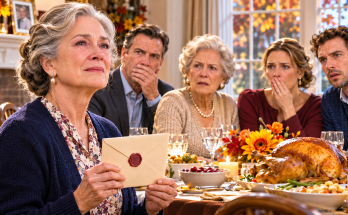
She removed a sealed envelope from her handbag.
Across the front was my name.
The handwriting belonged to my late husband, Edward.
And beneath my name were seven words that made my blood run cold.
To be delivered when Catherine is found.
Chapter Two: The Daughter Who Never Came Home
My daughter disappeared on October 17, 1998.
I remembered the date more clearly than my own birthday.
Catherine was eighteen years old, intelligent, independent, and determined to become an elementary school teacher.
She loved children, old novels, and spending afternoons drawing pictures beneath the maple tree in our garden.
Edward and I had raised her in a comfortable neighborhood outside Cincinnati, Ohio.
To outsiders, we appeared to be an ordinary, respectable family.
Edward managed a successful insurance agency.
I worked as a librarian.
We attended church, hosted holiday dinners, and took family vacations whenever our finances allowed.
But behind closed doors, Edward could be remarkably controlling.
He believed children should follow the expectations established by their parents.
He rarely tolerated disagreement.
As Catherine grew older, their arguments became increasingly frequent.
He disapproved of her clothing, friendships, and educational choices.
Then she began dating a young mechanic named Michael Bennett.
Michael came from a modest family.
He worked hard, spoke politely, and treated Catherine with affection.
I liked him.
Edward did not.
“He has no future,” Edward told me one evening.
“Then perhaps he’ll build one.”
“Catherine deserves better.”
“Shouldn’t Catherine decide that?”
Edward looked at me as though I had said something offensive.
Their disagreements worsened.
One afternoon, Catherine came home crying.
She refused to tell me what had happened.
When I asked Edward, he claimed she was behaving irresponsibly.
“She needs discipline, Dorothy.”
“She needs someone to listen to her.”
He dismissed my concern.
Then, on that October morning, I left for work shortly before eight.
Catherine was still upstairs.
I called goodbye from the hallway.
“Love you, sweetheart.”
“Love you, Mom.”
Those were the last words I heard from her for twenty-eight years.
When I returned that evening, her bedroom was empty.
Several dresses were missing.
So was her small blue suitcase.
Edward sat in the living room reading a newspaper.
“Where’s Catherine?”
He folded the newspaper slowly.
“She left.”
“Left for where?”
“She decided she wanted a different life.”
I stared at him.
“What are you talking about?”
He handed me a handwritten note.
It contained only a few sentences.
Mom, Dad, I’m sorry. I need to leave. Please don’t look for me. I want to make my own decisions.
The signature resembled Catherine’s.
I read the note repeatedly.
Then I rushed toward the telephone.
Edward stopped me.
“She’s eighteen, Dorothy.”
“I don’t care.”
“She made her choice.”
“Something is wrong.”
He insisted Catherine had left voluntarily.
Nevertheless, I contacted the police, explained the circumstances, and cooperated with the appropriate inquiries.
I telephoned her friends.
I contacted Michael’s family.
I searched places she might have visited.
Nobody seemed able to tell me where she was.
Edward became increasingly impatient.
“Eventually, she’ll contact us.”
But Catherine never called.
She never wrote.
Christmas passed.
Then her nineteenth birthday.
Then another Thanksgiving.
Every year, I kept her photograph beside the dining room window.
Every year, I hoped for her return.
Edward rarely spoke about her.
Whenever I mentioned searching again, he told me that Catherine had made her wishes clear.
“She doesn’t want us in her life.”
I never believed it.
Not completely.
But I had no idea that the man sleeping beside me knew considerably more than he had ever admitted.
Chapter Three: A Granddaughter I Never Knew Existed
I invited Emily into the house.
She removed her coat and followed me toward the living room.
Her eyes traveled slowly across the family photographs.
When she noticed Catherine’s graduation portrait, she stopped.
“Mom still has a copy of that.”
I looked at her.
“She does?”
Emily nodded.
“She keeps it in a wooden box with several other photographs.”
I sat down.
My hands were still trembling.
“Tell me everything.”
Emily took a deep breath.
“My mother is forty-six years old. She lives in Vermont.”
“Vermont?”
“Yes. That’s where I grew up.”
I struggled to understand.
For years, I had imagined Catherine living overseas, perhaps changing her name or beginning a life somewhere impossibly distant.
All that time, she had been living within the same country.
“Is Michael your father?”
Emily smiled sadly.
“Yes.”
A strange mixture of relief and sorrow washed over me.
“Are they married?”
“They were. Dad passed away four years ago.”
“Oh, sweetheart. I’m so sorry.”
She nodded.
“He was a wonderful father.”
Emily told me that Catherine had eventually become a teacher, fulfilling the dream she had spoken about throughout her childhood.
Michael had established a small automobile repair business.
They had purchased a modest house, worked hard, and raised two children.
“Two?”
Emily smiled.
“I have a younger brother named Benjamin.”
I began crying again.
Two grandchildren.
I had two grandchildren.
For years, I had watched other women proudly display photographs of their grandchildren at church.
I had smiled politely while they discussed school graduations, birthdays, and family vacations.
I never imagined that somewhere, children carrying my daughter’s features were growing up without knowing me.
“Why didn’t she contact me?” I whispered.
Emily looked down at the envelope.
“Grandma, she thought you didn’t want her.”
I stared at her.
“What?”
“She believed you and Grandpa had rejected her.”
I shook my head immediately.
“No. That’s impossible.”
Emily’s eyes filled with tears.
“That’s what she was told.”
I stood abruptly.
“I searched for her. I called her friends. I contacted the police. I wrote letters to every address I could find.”
“I know that now.”
“Then how could she believe I didn’t want her?”
Emily reached toward the envelope bearing Edward’s handwriting.
“I think Grandpa can explain that.”
I stared at it.
Edward had died three years earlier.
We had been married for forty-eight years.
I had believed I knew nearly everything about him.
Now, for the first time, I wondered whether I had known him at all.
Chapter Four: The Letter Edward Left Behind
Emily explained that a retired attorney named Robert Hayes had contacted her mother several weeks earlier.
Robert had once handled certain private matters for Edward.
Following Edward’s death, he had been instructed to deliver a sealed document to Catherine if her whereabouts could be independently established.
The process had taken time.
Eventually, with Catherine’s consent and verification of her identity, the letter reached her.
Catherine had opened the correspondence addressed to her.
But she had been too frightened to contact me personally.
Instead, Emily volunteered to come.
“She wanted to know whether you’d be willing to see her,” Emily explained.
I shook my head through my tears.
“Willing? I’ve waited twenty-eight years.”
Emily handed me Edward’s letter.
I opened it carefully.
The first words were unmistakably his.
Dorothy,
There is something I should have told you many years ago.
I have allowed you to grieve for our daughter while knowing that the circumstances of her departure were not what you believed.
There is no honorable way to explain what I did.
I stopped reading.
My heart was beating so quickly that I struggled to concentrate.
Emily sat beside me.
“Would you like me to read it?”
I nodded.
She took the letter and continued.
In September 1998, Catherine informed me that she was pregnant.
She intended to marry Michael Bennett and continue her education.
I believed she was making a terrible mistake.
I was ashamed of what people might say about our family, and I feared that her decisions would destroy the future I had planned for her.
I covered my mouth.
Catherine had been pregnant.
My little girl had been frightened, and I hadn’t known.
Emily continued.
I told Catherine that if she chose to keep the child and remain with Michael, she could no longer live in our house.
I also told her that you agreed with me.
I closed my eyes.
“No.”
My voice barely emerged.
“No, Edward.”
Emily’s voice trembled as she read the next paragraph.
She begged me to let her speak with you.
I refused.
I told her you were too disappointed to see her.
I arranged for her to leave before you returned from work.
The note she left was written under circumstances I deliberately misrepresented to you.
She believed you had chosen to reject her.
You believed she had chosen to abandon us.
Neither belief was true.
I began sobbing.
For twenty-eight years, I had imagined my daughter leaving without saying goodbye.
For twenty-eight years, I had wondered what I had done wrong.
And all that time, Edward had known.
Emily placed the letter on the table and wrapped her arms around me.
I held my granddaughter for the first time.
Neither of us spoke.
There were no words large enough to contain what had been taken from us.
Chapter Five: The Letters That Never Arrived
After several minutes, I gathered enough strength to continue reading.
Edward’s confession became even more painful.
During the months following Catherine’s departure, she attempted to contact us.
She wrote several letters.
I received them.
I did not give them to you.
I answered some of her correspondence myself, telling her that we respected her decision to leave and did not wish to reopen the matter.
When she informed me that her daughter had been born, I did not respond.
I looked toward Emily.
“You were born, and he knew?”
She nodded slowly.
“Mom kept copies of the letters she sent.”
I remembered the spring of 1999.
I had spent weeks planting flowers beneath Catherine’s bedroom window.
I had imagined her returning to find the garden beautiful.
Meanwhile, my first grandchild had entered the world.
Edward had known.
He had sat across from me at breakfast.
He had accompanied me to church.
He had watched me cry on Mother’s Day.
And he had said nothing.
I returned to the letter.
Over time, I convinced myself that revealing the truth would destroy our marriage.
Each year that passed made confession more difficult.
I was wrong to believe that protecting my reputation mattered more than protecting our daughter.
I understand that nothing I write can return the years I took from you.
If Catherine is willing, please find her.
Tell her that I was wrong.
Tell her that her mother never stopped loving her.
And Dorothy, I am sorry.
The letter ended there.
No explanation could have been sufficient.
No apology could have returned twenty-eight Christmas mornings.
Twenty-eight birthdays.
Graduations.
Wedding celebrations.
The births of grandchildren.
The ordinary telephone calls between a mother and daughter.
All those moments had existed somewhere in the world.
I simply hadn’t been allowed to share them.
I looked toward Edward’s photograph on the mantelpiece.
For three years, I had mourned him as the man with whom I had shared nearly half a century.
Now I found myself grieving something else.
The marriage I believed we had possessed.
I felt anger, sadness, disbelief, and betrayal.
And beneath all of it was a desperate desire to see my daughter.
“Emily?”
“Yes?”
“Can you call your mother?”
She reached for her telephone.
Then she hesitated.
“Grandma, she’s afraid.”
“Of what?”
“That you’ll blame her.”
My heart broke again.
“Please tell her that the only thing I’ve wanted for twenty-eight years is to hear her voice.”
Emily nodded.
She selected a number and pressed the call button.
Several seconds passed.
Then I heard a familiar voice.
“Emily? Is everything all right?”
I covered my mouth.
It was Catherine.
Older.
Different.
Yet unmistakably my daughter.
Emily handed me the telephone.
I pressed it against my ear.
“Catherine?”
Silence.
Then came a trembling whisper.
“Mom?”
I closed my eyes.
“Hello, my beautiful girl.”
Chapter Six: The Conversation We Had Waited For
For nearly a minute, neither of us managed to speak coherently.
I cried.
Catherine cried.
Emily sat beside me, holding my hand.
Finally, Catherine whispered, “I thought you hated me.”
“Oh, sweetheart. Never.”
“Dad said you were ashamed.”
“I didn’t know.”
“He told me you didn’t want to see me.”
“I searched for you, Catherine.”
She began crying harder.
“I wrote letters.”
“I never received them.”
There was another long silence.
Then she asked, “You really didn’t know about Emily?”
“No.”
“Or Benjamin?”
“No, darling.”
Her breathing became uneven.
“I thought you knew everything.”
I looked at my granddaughter.
“I only found out this morning.”
Catherine explained that after leaving home, she and Michael had struggled considerably.
They moved to Vermont, where one of Michael’s relatives helped them find temporary accommodation.
Michael worked long hours repairing vehicles.
Catherine completed her education gradually while raising Emily.
Eventually, they married and established a stable home.
Their lives had not been easy.
But Michael had remained beside her.
When their son Benjamin was born, Catherine had written another letter to Edward.
She included photographs.
No answer came.
After several more unsuccessful attempts, she stopped writing.
“I couldn’t keep begging my parents to love me,” she whispered.
Those words nearly destroyed me.
“You never had to beg for my love.”
“I know that now.”
I told her about the police report, my searches, and the years I had spent wondering whether she was safe.
I described the photographs I had kept and the birthday cards I had written but never mailed because I had no address.
Catherine listened quietly.
Then she told me something unexpected.
“Mom, I still make your apple pie.”
I laughed through my tears.
“You do?”
“Every Thanksgiving. Michael loved it.”
I glanced toward the kitchen.
“I made one this morning.”
“Of course you did.”
For a moment, the years between us seemed to disappear.
We were simply a mother and daughter discussing Thanksgiving dinner.
Then Catherine became quiet.
“Can I see you?”
I smiled.
“Nothing would make me happier.”
There was a pause.
“I’m actually closer than you think.”
I looked toward Emily.
My granddaughter smiled.
“Mom and Benjamin came with me. They’re staying at a hotel about fifteen minutes away.”
I stared at her.
“You mean she’s here?”
Emily nodded.
I returned to the telephone.
“Catherine, come home.”
Her voice broke.
“Are you sure?”
I stood, already walking toward the hallway.
“Your dinner is getting cold.”
Chapter Seven: The Woman on My Porch
Those fifteen minutes felt longer than twenty-eight years.
I moved nervously around the house.
I straightened cushions that didn’t need straightening.
I checked the turkey twice.
I adjusted Catherine’s graduation photograph on the mantelpiece.
Then I stood beside the front window.
Emily watched me with a gentle smile.
“Grandma, she’s nervous too.”
“I don’t know what to say to her.”
“You don’t need to prepare anything.”
I nodded.
But how did a mother greet a daughter she had last seen at eighteen?
Would she look like the girl I remembered?
Would I recognize her voice immediately?
Would she feel comfortable embracing me?
A dark blue car finally turned into the driveway.
My heart began pounding.
The passenger door opened.
A woman stepped outside.
She wore a cream-colored coat and carried a brown handbag.
Her hair was shorter than I remembered, with several silver strands near her temples.
She turned toward the house.
I recognized her immediately.
Not because she looked exactly as she had at eighteen.
Because a mother remembers more than a face.
The way she stood.
The way she tilted her head.
The nervous habit of pressing her lips together.
I opened the front door before she reached the porch.
She stopped.
“Mom?”
I stepped outside.
“Catherine.”
For a moment, she remained motionless.
Then she ran toward me.
I wrapped my arms around her.
She buried her face against my shoulder and began crying.
“I’m sorry, Mom.”
“No, sweetheart.”
“I should have tried harder.”
“You were eighteen.”
“I believed him.”
“So did I.”
We held each other beneath the cold November sky.
Twenty-eight years of sorrow could not disappear in a single embrace.
But that embrace was a beginning.
When Catherine finally stepped back, I placed my hands against her cheeks.
“Let me look at you.”
She laughed through her tears.
“I’m not eighteen anymore.”
“No.”
I smiled.
“But you’re still my daughter.”
Then a young man approached us.
He was tall, with dark hair and a kind expression.
“Grandma?”
I looked at him.
“Benjamin?”
He nodded.
I hugged him, too.
For years, I had believed my family had become smaller with every passing season.
Now, standing on my front porch, I discovered it was larger than I had ever imagined.
Chapter Eight: Thanksgiving Dinner After Twenty-Eight Years
I had prepared enough food for perhaps two people.
Somehow, we managed to make it serve four.
Emily helped arrange the table.
Benjamin carried dishes from the kitchen.
Catherine stood beside the stove, examining the old roasting pan.
“You still have this?”
“Of course.”
She laughed.
“I remember helping you wash it after Thanksgiving.”
I smiled.
“You complained the entire time.”
“I was a teenager.”
“You certainly were.”
We laughed together.
Then, almost unexpectedly, Catherine began crying again.
I placed the serving spoon on the counter.
“What’s wrong?”
“I missed this.”
I reached for her hand.
“So did I.”
We sat down shortly afterward.
For a while, nobody knew where to begin.
Then Benjamin asked about his mother’s childhood.
I told him about the time Catherine brought an injured bird into the kitchen and insisted we care for it.
Emily laughed.
“That sounds exactly like Mom.”
Catherine shook her head.
“It was a very small bird.”
“It was also a very large mess,” I replied.
For the first time in decades, laughter filled my dining room.
My grandchildren told me about their lives.
Emily worked as an elementary school teacher, following in her mother’s footsteps.
Benjamin was studying engineering.
They showed me photographs of their childhood, family vacations, birthday celebrations, and school graduations.
Then Emily opened a photograph of Michael.
He was older than the young mechanic I remembered.
His hair had thinned, and his face had developed the gentle lines of middle age.
He stood beside Catherine, holding a birthday cake.
“He really loved you,” I said.
Catherine smiled sadly.
“He did.”
She told me about their marriage.
About the little house they purchased.
About the business Michael established.
About his final illness and the way their children supported her afterward.
I wished I had been there.
I wished I had known the man who had remained beside my daughter when her own parents seemed to abandon her.
“I’m sorry I never got to thank him,” I whispered.
Catherine took my hand.
“He knew you loved me.”
I looked at her.
“How?”
“Because I told him about the mother I remembered before everything happened.”
She smiled through her tears.
“He used to say that someday we’d understand what really happened.”
I looked down at my plate.
Michael had carried hope even when Catherine struggled to believe it.
I would always be grateful to him for that.
Before we finished dinner, Benjamin raised his glass.
“To Grandma.”
Emily lifted hers.
Catherine looked at me.
“To coming home.”
I raised my glass, barely able to see through my tears.
“To the years we still have.”
Chapter Nine: The Box Hidden in Edward’s Study
After dinner, Catherine asked whether she could see her old bedroom.
I led her upstairs.
The room had changed little since her departure.
The wallpaper was faded.
Her childhood books remained on the shelves.
Several stuffed animals sat beside the window.
Catherine stopped in the doorway.
“You kept everything.”
I nodded.
“I couldn’t bring myself to change it.”
She walked toward the dresser and picked up a small porcelain jewelry box.
“I thought Dad would have thrown all this away.”
“He suggested it several times.”
She looked at me.
“But you didn’t.”
“No.”
We stood together for several moments.
Then I remembered Edward’s study.
His letter had referred to correspondence he had withheld from me.
I wondered whether any of it still existed.
Edward had kept important records in a locked cabinet.
Following his death, I had sorted most of the documents, although several sealed folders remained untouched.
I asked Catherine to come downstairs with me.
Emily and Benjamin joined us.
Inside the study, I opened the cabinet and removed several storage boxes.
We examined insurance records, personal correspondence, and old financial documents.
Then Emily found a brown envelope tucked beneath a stack of papers.
“Grandma?”
She held it toward me.
Written across the front was one word.
Catherine.
I opened it.
Inside were photographs.
The first showed a newborn baby wrapped in a pink blanket.
On the back, Catherine had written:
Emily Rose Bennett. Born April 26, 1999.
I stared at the photograph.
My granddaughter.
Just days old.
Beneath it was a handwritten letter.
Dear Mom and Dad,
Emily arrived safely. She is beautiful, and Michael is already completely in love with her.
I wish you could meet her.
Mom, I think about you every day. I hope someday you will forgive me.
I pressed the letter against my chest.
Catherine began crying.
“I remember writing that.”
There were more photographs.
Emily taking her first steps.
Catherine in a graduation gown.
Michael standing outside his repair shop.
Benjamin as a newborn.
The final letter had been written in 2005.
Mom, I don’t understand why you won’t speak to me.
I have tried to respect your wishes, but I miss you so much.
I hope you know that whatever happened, I will always love you.
I could barely finish reading.
For years, Edward had possessed tangible evidence of Catherine’s desire to reconnect.
He had chosen to conceal it.
I looked toward his empty chair.
The anger I felt was unlike anything I had experienced before.
Yet when Catherine began apologizing again, I took her hands.
“Listen to me carefully.”
She looked up.
“We are not going to spend the rest of our lives apologizing to each other for something neither of us chose.”
She nodded.
Then we embraced again.
Chapter Ten: Learning to Remember Honestly
The following weeks were emotionally difficult.
Catherine returned to Vermont after Thanksgiving, but we spoke every evening.
Sometimes our conversations lasted ten minutes.
Sometimes they lasted three hours.
There was so much to discover.
What had happened on her wedding day?
How had Emily chosen teaching?
What had Benjamin been like as a little boy?
Which traditions had Catherine continued?
Which ones had she created herself?
Every conversation filled another small gap in the enormous collection of years we had lost.
But reconnecting also brought difficult emotions.
Catherine struggled with anger toward Edward.
So did I.
There were days when I could barely look at his photograph.
I remembered our anniversaries, vacations, and quiet evenings together.
Those memories had been real.
So had his deception.
Reconciling those truths was painful.
One afternoon, Catherine asked me whether I still loved him.
I considered the question carefully.
“I loved the man I believed he was.”
She nodded.
“And now?”
“Now I’m trying to understand how someone I loved could have made choices that caused so much suffering.”
I didn’t want to pretend Edward had never done anything good.
But neither would I minimize the damage he caused.
Eventually, Catherine and I agreed to speak with a family counselor.
We needed space to process our grief, anger, and the complicated feelings surrounding our reunion.
We learned that reconnecting after decades of separation required patience.
We couldn’t instantly become the mother and daughter we might have been.
Catherine was now an independent woman with her own routines, memories, and family traditions.
I was an elderly widow with a life shaped by years of absence.
We needed to discover who we had become rather than expect each other to remain unchanged.
That Christmas, I traveled to Vermont.
Catherine insisted I stay in her guest bedroom.
When I entered her house, I noticed something familiar beside the staircase.
It was a photograph of me holding her as a baby.
She saw me looking at it.
“I never stopped being your daughter,” she said.
I turned toward her.
“And I never stopped being your mother.”
Chapter Eleven: A Family Album With Missing Pages
During my visit, Emily brought out several large family albums.
We spent an entire afternoon looking through them.
There were photographs of nearly every birthday.
Christmas mornings.
School performances.
Summer vacations.
Catherine’s wedding.
Emily’s college graduation.
Benjamin’s first bicycle.
At first, looking through the photographs made me painfully aware of everything I had missed.
But gradually, something changed.
Instead of mourning each moment, I began appreciating that those moments had happened.
My daughter had built a meaningful life.
She had loved and been loved.
She had become a devoted mother.
She had fulfilled her professional dreams.
Despite the cruelty she experienced at eighteen, she had not allowed it to determine the remainder of her life.
I felt immensely proud of her.
One evening, Catherine and I visited Michael’s grave.
Snow covered the surrounding grass.
She placed flowers beside his headstone.
I stood quietly for several moments.
Then I spoke.
“Thank you for taking care of my daughter.”
Catherine began crying.
I continued.
“Thank you for helping her build a home when she believed she had lost hers.”
The wind moved gently through the trees.
I wished Michael could have witnessed our reunion.
But I hoped that somewhere, somehow, the man who had loved Catherine through those difficult years would have been pleased.
On our way home, Catherine asked whether I wanted to visit Edward’s grave together someday.
I told her that decision belonged to her.
“You don’t owe anyone forgiveness before you’re ready.”
She nodded.
Several months later, she decided to make the visit.
She stood beside his grave for a long time.
I remained several feet away.
When she returned, her expression was peaceful but sad.
“What did you say?” I asked.
She looked toward the distant trees.
“I told him that I was happy.”
Then she smiled faintly.
“And that he was wrong about Michael.”
I reached for her hand.
We walked back toward the car together.
Chapter Twelve: The Wedding Invitation
In early spring, Emily telephoned me with exciting news.
She was getting married.
Her fiancé, Daniel, was a kind young man she had met while attending college.
They had been together for several years.
“Grandma, I want you at the wedding.”
I laughed.
“Try keeping me away.”
Then she asked something that surprised me.
“Would you help Mom choose her dress?”
I smiled.
“I would love to.”
Several weeks later, Catherine and I visited a little clothing shop together.
She tried on several dresses while I sat outside the fitting room.
When she emerged wearing a beautiful pale blue dress, I began crying.
“Mom?”
I wiped my eyes.
“I missed helping you choose your wedding dress.”
She walked toward me.
“I know.”
I looked at her reflection in the mirror.
“You look beautiful.”
She sat beside me and took my hand.
“Then let’s enjoy this one.”
Emily’s wedding took place in September.
The ceremony was held in a garden surrounded by flowering trees.
Benjamin walked beside his sister.
Catherine sat in the front row.
And beside her was a chair reserved especially for me.
During the reception, Emily approached the microphone.
She thanked her mother, remembered her father, and expressed gratitude to everyone who had supported her.
Then she looked toward me.
“Last Thanksgiving, I met someone I had spent my entire life wondering about.”
I felt tears gathering.
“My grandmother.”
The room became quiet.
“She taught me that sometimes family stories have missing chapters. But finding those chapters can make the ending more beautiful.”
She smiled.
“Grandma, would you dance with me?”
I laughed through my tears.
“My knees might disagree.”
Everyone laughed.
Emily helped me stand.
Together, we walked toward the dance floor.
Catherine joined us.
Then Benjamin.
For a few minutes, three generations of my family stood together beneath the warm lights.
I thought about all the celebrations I had missed.
Then I looked at the people surrounding me.
I wasn’t going to miss this one.
Chapter Thirteen: The Thanksgiving I Had Always Imagined
One year after Emily first knocked on my door, Thanksgiving returned.
This time, my house was filled with people.
Catherine arrived two days early.
Emily and Daniel brought groceries.
Benjamin helped repair a loose cabinet door.
My daughter stood beside me in the kitchen, preparing cranberry sauce while I rolled pastry for our apple pies.
The radio played holiday music.
Outside, golden leaves scattered across the garden.
Everything felt familiar.
And everything was new.
While Catherine measured flour, she glanced toward me.
“Mom?”
“Yes?”
“Do you ever wish we could start those twenty-eight years over?”
I stopped working.
“Every day.”
She nodded.
Then I continued.
“But I don’t want to spend the years we have left wishing for years we cannot recover.”
She smiled.
“Neither do I.”
When dinner was ready, we gathered around the table.
There were photographs of Michael, my parents, and several other loved ones who were no longer with us.
I had also placed Catherine’s eighteenth birthday photograph beside a recent picture of her with Emily and Benjamin.
The young woman who had disappeared.
The mother she had become.
Two images separated by nearly three decades.
Yet both were my daughter.
Before we began eating, Emily stood.
“I have another announcement.”
Daniel smiled beside her.
Catherine looked surprised.
Emily reached into her handbag and removed a small white envelope.
She handed it to her mother.
Inside was an ultrasound photograph.
Catherine stared at it.
Then she screamed with delight.
“Emily!”
Everyone began laughing.
I covered my mouth.
“Are you telling me…”
Emily nodded.
“You’re going to be a great-grandmother.”
I cried so hard that Catherine had to hand me a napkin.
For twenty-eight years, I had believed I might never see my daughter again.
Now, I was being given the opportunity to welcome another generation into our family.
A child whose birthdays I might attend.
Whose little hands I might hold.
Whose mother would tell stories about the Thanksgiving when our family finally found one another.
I looked around the table.
“Your grandfather made a terrible mistake,” I said softly.
Everyone became quiet.
“He allowed fear, pride, and shame to separate people who loved each other.”
Catherine reached for my hand.
“But we’re going to do things differently.”
Emily smiled.
“We already are, Grandma.”
We raised our glasses.
Not to the years we had lost.
To the years ahead.
Chapter Fourteen: My Daughter Finally Came Home
That evening, after dinner, Catherine and I sat together on the porch.
A light snowfall had begun.
Inside, Emily and Daniel were discussing baby names.
Benjamin was helping clear the dishes.
The house glowed warmly behind us.
Catherine rested her head against my shoulder.
“I’m glad Emily came to find you.”
“So am I.”
She hesitated.
“Mom, there’s something I never told you.”
I turned toward her.
“What is it?”
“Every Thanksgiving, after everyone went to bed, I used to take out your photograph.”
My throat tightened.
“I would look at it and wonder whether you were thinking about me.”
I reached for her hand.
“Every Thanksgiving.”
She began crying.
“Really?”
“Every single one.”
We sat quietly beneath the porch light.
I thought about how differently our lives might have unfolded if Edward had chosen compassion instead of control.
If he had allowed Catherine to speak to me.
If he had delivered even one of those letters.
Twenty-eight years might have been saved by a single honest conversation.
But the past could not be changed.
I could not return Catherine’s childhood.
I could not meet Michael while he was alive.
I could not hold Emily or Benjamin as newborn babies.
What I could do was love them now.
Listen to them now.
Celebrate with them now.
And refuse to allow another day to disappear unnecessarily.
Catherine squeezed my hand.
“I love you, Mom.”
I smiled through my tears.
“I love you too, sweetheart.”
Those were the same words we had exchanged on the morning she disappeared.
Only this time, neither of us was walking away.
Later that evening, I returned to the dining room.
The table was covered with empty plates, scattered napkins, and the remains of our Thanksgiving dinner.
For years, I had hated cleaning up after eating alone.
That night, I welcomed every dirty plate.
Every misplaced glass.
Every crumb of apple pie.
They were evidence that my house had been filled with people who loved me.
I walked toward Catherine’s graduation photograph and placed Emily’s ultrasound picture beside it.
Then I stood there smiling.
My husband’s secret had stolen twenty-eight years.
But it would not steal another Thanksgiving.
For the first time in decades, I no longer needed to leave the porch light burning in the hope that my daughter might find her way home.
She already had.
And tomorrow morning, when I walked into the kitchen, she would be there.
Perhaps making coffee.
Perhaps complaining that I had put too much cinnamon in the apple pie.
Perhaps laughing about something completely ordinary.
After twenty-eight years, ordinary was everything I wanted.
I turned off the dining room light and listened to the laughter coming from the living room.
My daughter was home.
My grandchildren were here.
And somewhere in the months ahead, a new little life would join our family.
I had once believed my story would end with an unanswered question and an empty chair.
Instead, at seventy-five, I discovered that even after decades of heartbreak, life could still offer an unexpected beginning.
Some wounds never disappear completely.
Some years can never be recovered.
But love, when finally given the freedom to speak, can find its way across even the longest silence.
THE END