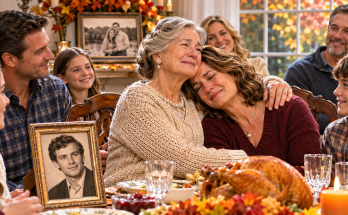
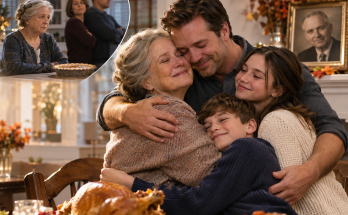
Chapter One: The Man at Table Seven
The first Thanksgiving I met Walter, he was sitting alone at table seven, wearing a faded brown coat and counting quarters beneath the fluorescent lights of our little diner.
It was November 2008.
Outside, freezing rain covered the streets of a small town in Pennsylvania. Most businesses had closed for the holiday, and the few customers who came through our doors were travelers, truck drivers, and people who had nowhere else to go.
I was forty-six years old, working a double shift at Miller’s Family Diner.
My name is Catherine Miller, though everyone in town called me Cathy.
Despite the name, I didn’t own the diner. It belonged to an elderly couple who happened to share my surname. I had worked there for eleven years, serving coffee, remembering customers’ birthdays, and stretching my paycheck far enough to keep a roof over my daughter’s head.
My husband, Peter, had died three years earlier.
He left behind wonderful memories, several unpaid medical bills, and a daughter who was determined to attend college.
Life wasn’t easy, but we managed.
That Thanksgiving afternoon, I approached the elderly stranger with a coffee pot.
“Can I get you something warm?”
He glanced at the menu.
“How much is a cup of coffee?”
“Two dollars.”
He looked down at the coins in his palm.
“Just coffee, then.”
I noticed his eyes lingering on the Thanksgiving special advertised above the counter.
Roast turkey, mashed potatoes, stuffing, vegetables, cranberry sauce, and pumpkin pie.
“Would you like some dinner with that?” I asked.
He shook his head.
“Coffee will be enough.”
I knew that look.
I had worn it myself while standing in grocery stores, quietly calculating whether I could afford everything in my basket.
I poured his coffee and returned to the kitchen.
Ten minutes later, I placed a complete Thanksgiving dinner in front of him.
He stared at the plate.
“I didn’t order this.”
“I know.”
“I can’t pay for it.”
“Good thing it’s already paid for.”
He looked at me suspiciously.
“By whom?”
“Someone who thinks nobody should spend Thanksgiving hungry.”
He glanced around the diner, perhaps searching for his mysterious benefactor.
Then he looked back at me.
“You?”
I smiled.
“Your coffee’s getting cold.”
For several seconds, he remained motionless.
Then he picked up his fork.
He ate slowly, carefully, as though he wanted every mouthful to last.
When he finished, I brought him a slice of pumpkin pie.
He shook his head in disbelief.
“You’re going to spoil me.”
“That’s allowed on Thanksgiving.”
He laughed.
It was a quiet, unexpected laugh, and something about it reminded me of my father.
Before leaving, he reached into his coat pocket and removed a folded dollar bill.
He placed it beside his empty coffee cup.
“Thank you, Catherine.”
I glanced at my name badge.
“You’re welcome. And you are?”
“Walter.”
“Happy Thanksgiving, Walter.”
He paused beside the door.
“Happy Thanksgiving to you, too.”
I watched him disappear into the freezing rain.
I assumed I would never see him again.
I was wrong.
Chapter Two: A Thanksgiving Tradition
Exactly one year later, Walter returned.
He arrived shortly after two in the afternoon, wearing the same brown coat and carrying a small paperback novel.
Without asking, he walked toward table seven.
I recognized him immediately.
“Well, look who’s back.”
He smiled.
“I was hoping you’d still be here.”
“Where else would I be?”
He removed his coat and carefully folded it across the empty chair beside him.
“Coffee?”
“And dinner,” I answered.
He reached for his wallet.
“Catherine, you don’t have to do that again.”
“I know.”
“Then why are you doing it?”
“Because I want to.”
He studied my face.
Then he nodded.
That afternoon, I learned a little more about him.
Walter said he had once been married.
His wife, Eleanor, had died several years earlier.
They had enjoyed traveling, gardening, and hosting Thanksgiving dinners that attracted more guests than their dining room could comfortably accommodate.
“She always cooked too much,” he told me.
“Sounds like a wonderful woman.”
“She was.”
He looked toward the window.
“After she died, holidays became rather difficult.”
I understood.
There were certain kinds of loneliness that could not be explained to someone who had never experienced them.
Peter’s absence had changed every celebration in our home.
His empty chair remained more noticeable than all the people gathered around it.
Walter and I spoke about our spouses for nearly an hour.
I told him how Peter used to burn the Thanksgiving rolls.
Walter told me how Eleanor insisted on making cranberry sauce from scratch, even though nobody could tell the difference between hers and the canned variety.
We laughed.
For a little while, neither of us seemed quite so lonely.
Before leaving, Walter placed another folded dollar bill beneath his coffee cup.
“Tradition,” he explained.
I tucked it into my apron.
“Same time next year?”
He smiled.
“I’d like that.”
And so our tradition began.
Every Thanksgiving, Walter arrived at Miller’s Family Diner.
Every Thanksgiving, he sat at table seven.
And every Thanksgiving, I served him dinner without charging him.
Sometimes he brought a book.
Sometimes he brought an interesting newspaper article.
One year, he brought a small bag of homemade peppermint candies.
Another year, he arrived carrying a wooden Christmas ornament he said he had made himself.
He never told me much about his finances or his family.
I assumed he was a retired factory worker surviving on a modest pension.
His clothes were clean but old.
His shoes had been repaired more than once.
He drove an aging gray Buick that sounded as though it might surrender at any moment.
Nothing about Walter suggested wealth.
But there was something about the way he listened.
Whenever I spoke, he gave me his complete attention.
He remembered my daughter’s name, her ambitions, and even the subjects she struggled with at school.
He asked questions that made me think differently about my circumstances.
Sometimes, I wondered whether I was feeding him because he needed companionship or because I needed it myself.
Perhaps it was both.
Chapter Three: The Question He Asked Every Year
My daughter, Emily, was seventeen when Walter first came into the diner.
She dreamed of becoming a nurse.
Unfortunately, dreams were expensive.
Even with scholarships and financial assistance, there were tuition costs, textbooks, transportation expenses, and countless unexpected bills.
I accepted extra shifts whenever possible.
Some weeks, I worked nearly sixty hours.
There were evenings when my feet hurt so badly that I sat in my car for ten minutes before finding the strength to drive home.
Yet I never considered giving up.
Peter and I had always wanted Emily to have opportunities we never had ourselves.
On Thanksgiving in 2011, Walter noticed how tired I looked.
“Have you been sleeping, Catherine?”
“Occasionally.”
He frowned.
“That doesn’t sound like enough.”
“College isn’t getting any cheaper.”
“How’s Emily doing?”
“She’s doing wonderfully. She passed all her examinations.”
“You must be proud.”
“More than you can imagine.”
He stirred his coffee thoughtfully.
“Do you ever wish someone would make things easier for you?”
I laughed.
“Every time the electric bill arrives.”
“I’m serious.”
I leaned against the edge of the table.
“Of course I do. But everyone has something they’re dealing with.”
Walter looked at me for several seconds.
“What would you do if you suddenly had enough money not to worry anymore?”
I considered the question.
“Pay off my debts. Help Emily finish school. Fix the roof.”
“And after that?”
“I don’t know.”
“Surely there’s something you’ve always wanted.”
I smiled.
“I’d love to own a little restaurant someday.”
“What kind?”
“Nothing fancy. Somewhere people could come for a good meal without feeling they had to dress up or spend half their paycheck.”
Walter nodded.
“And what would you do about people who couldn’t afford dinner?”
I glanced at his plate.
“I suppose I’d find a way to feed them.”
He laughed softly.
“I thought you might say that.”
Over the years, Walter asked variations of the same question.
What would I do if I had more money?
What did I consider success?
What mattered most to me?
I assumed he was simply an elderly man interested in conversation.
I never imagined that he was remembering every answer.
Chapter Four: The Envelope I Refused
In November 2015, Walter arrived carrying a cream-colored envelope.
He was moving more slowly than before, and I noticed that his hands trembled slightly when he removed his coat.
“You’re looking tired,” I told him.
“I’m eighty years old, Catherine. Looking tired is practically my occupation.”
I laughed and poured his coffee.
After dinner, he placed the envelope on the table.
“I have something for you.”
“What is it?”
“A little help.”
I opened it.
Inside was a personal check for $5,000.
My smile disappeared.
“Walter, what is this?”
“Exactly what it looks like.”
“I can’t accept five thousand dollars from you.”
“Why not?”
“Because you need it.”
He leaned back.
“How do you know what I need?”
I looked at his worn coat.
His repaired shoes.
His old car parked outside.
“Walter, I appreciate the gesture, but this is too much.”
“You’ve been kind to me for years.”
“I didn’t do it because I expected something.”
“I know.”
“Then please don’t make me feel as though I owe you anything.”
He looked genuinely surprised.
“Catherine, that’s the last thing I would want.”
I returned the check.
“Keep your money. Buy yourself a warmer coat.”
He examined the envelope, then slowly slipped it back into his pocket.
“You’re a stubborn woman.”
“So I’ve been told.”
He smiled.
“Eleanor would have liked you.”
Before he left, he placed a dollar beneath his coffee cup, just as he always did.
This time, however, there was something different about his expression.
He looked almost relieved.
As though I had answered another question without realizing he had asked it.
Chapter Five: The Winter Everything Changed
In early 2020, my life began unraveling.
The diner temporarily closed during the pandemic, and my income disappeared almost overnight.
Although Emily had become a registered nurse, I refused to burden her financially. She had student loans and responsibilities of her own.
I applied for assistance, reduced my expenses, and used what little savings I had accumulated.
Still, the bills continued arriving.
One afternoon, I received a telephone call from an unfamiliar number.
“Is this Catherine Miller?”
“Yes.”
“My name is James Holloway. I’m calling on behalf of someone who would like to assist you.”
I immediately became suspicious.
“Assist me with what?”
“Your outstanding mortgage payments.”
I sat down.
“How do you know about my mortgage?”
He explained that an anonymous benefactor wished to provide financial assistance through an established charitable arrangement.
He did not ask for my banking password, security information, or payment.
He provided verifiable contact details and encouraged me to consult the mortgage company independently.
I remained cautious.
Several days later, after confirming the arrangement directly with my mortgage provider, I learned that the overdue payments had been covered.
I cried.
I had spent weeks wondering whether I might lose my home.
Someone had quietly removed that fear.
When the diner reopened, I asked Walter whether he knew anything about it.
He looked genuinely puzzled.
“Someone paid your mortgage?”
“The overdue payments.”
“That sounds rather generous.”
“Do you know anything about it?”
He buttered a dinner roll.
“Perhaps someone wanted to help a person who needed it.”
I studied him.
“Walter?”
“Catherine?”
“Are you hiding something from me?”
He smiled.
“Everyone has a few secrets.”
I shook my head.
“You’re impossible.”
He laughed and continued eating.
I had no proof that he was involved.
But from that afternoon forward, I began wondering whether there was considerably more to Walter than the lonely pensioner I believed him to be.
Chapter Six: His Last Thanksgiving
By Thanksgiving 2024, Walter was ninety.
He arrived at the diner shortly after noon, leaning on a wooden walking stick.
His brown coat had finally been replaced with a dark blue one.
“Look at you,” I said. “A new coat.”
“Secondhand.”
“Still an improvement.”
He smiled.
I helped him settle into his usual booth.
His hands trembled as he lifted his coffee cup, and he seemed unusually tired.
“Have you been feeling all right?”
“Oh, a few complaints. Nothing unusual for an old man.”
“Are you seeing your doctor?”
“Regularly.”
He looked around the diner.
Much had changed since our first Thanksgiving.
The original owners had retired.
Several familiar customers had passed away.
The walls had been repainted, and the old jukebox had been removed.
But table seven remained.
And so did we.
After dinner, Walter asked whether I had any plans for retirement.
“Retirement?” I laughed. “I’ll probably be pouring coffee until somebody takes the pot away from me.”
“What about your restaurant?”
“That was just a dream.”
“Why?”
“Because dreams need money, Walter.”
He nodded thoughtfully.
“Would you still want it?”
I looked toward the kitchen.
“Sometimes.”
“What would you call it?”
I considered the question.
“Eleanor’s Table.”
Walter stopped moving.
For a moment, I worried that I had upset him.
“Would you mind?” I asked.
His eyes filled with tears.
“Why Eleanor?”
“Because you’ve told me so many stories about her. She sounded like someone who understood what a good meal could mean to people.”
Walter reached across the table and took my hand.
“She would have been honored.”
We sat quietly.
Then he reached into his coat and removed a small photograph.
It showed him and Eleanor standing outside a restaurant many years earlier.
They looked happy.
Young.
Full of plans.
“Keep this for me,” he said.
“Walter, it belongs to you.”
“I have another copy.”
I slipped it carefully into my apron pocket.
Before leaving, he placed a dollar beneath his coffee cup.
Then he surprised me by asking for a hug.
I wrapped my arms around him.
He held on a little longer than usual.
“Thank you for seventeen Thanksgivings, Catherine.”
I smiled.
“You can thank me properly next year.”
He pulled away.
“I hope so.”
Something in his voice made me uneasy.
“Promise me you’ll come back.”
Walter looked at me with a tenderness I would never forget.
“I’ll do my best.”
That was the last time I saw him alive.
Chapter Seven: The Empty Booth
Thanksgiving arrived the following year.
I reserved table seven before the diner opened.
I placed a clean napkin beside the cutlery and made sure Walter’s favorite coffee was available.
At noon, I glanced toward the entrance.
At one, I looked again.
By two thirty, I was becoming concerned.
Perhaps the weather had delayed him.
Perhaps his car had broken down.
Perhaps he wasn’t feeling well.
I tried calling the number he had given me several years earlier, but nobody answered.
At four, I placed a fresh cup of coffee on his table.
It remained untouched.
One of my coworkers noticed.
“Cathy, are you expecting someone?”
“Yes.”
“Should I clear the table?”
“Not yet.”
By closing time, I knew something was wrong.
Walter had never missed Thanksgiving.
Not once in seventeen years.
I sat in his booth after my shift ended.
Across from me stood an empty chair.
I thought about all the stories he had shared.
All the questions he had asked.
All the times he had listened when I needed somebody to talk to.
I realized I knew surprisingly little about his life beyond the diner.
I didn’t know where he lived.
I didn’t know whether he had children.
I didn’t even know his surname.
To me, he had always been Walter.
Just Walter.
Three days later, shortly before the lunchtime rush, a man in an expensive gray suit entered the diner.
He carried a leather briefcase and approached the counter.
“Excuse me. I’m looking for Catherine Miller.”
“That’s me.”
He extended his hand.
“My name is James Holloway.”
The name sounded familiar.
Then I remembered the mortgage assistance.
“You called me several years ago.”
He nodded.
“I did.”
“Is something wrong?”
He glanced toward the dining room.
“Could we speak privately?”
I led him to table seven.
When he saw the number attached to the booth, he stopped.
“Is this where Walter used to sit?”
My heart tightened.
“You know Walter?”
He removed his glasses.
“Mrs. Miller, I’m afraid I have some difficult news.”
I already knew what he was going to say.
But hearing it still broke my heart.
“Walter passed away three weeks ago.”
I stared at the empty chair.
For several seconds, I couldn’t respond.
Then I asked the only question that mattered to me.
“Was he alone?”
Mr. Holloway shook his head.
“No. He was receiving excellent care, and several people who cared deeply about him were present.”
I wiped my eyes.
“Thank goodness.”
He waited patiently.
Then he opened his briefcase.
“Walter left instructions concerning you.”
“Concerning me?”
“Yes.”
He removed a sealed envelope.
Across the front, in Walter’s unmistakable handwriting, were the words:
For Catherine, the woman who always made room at her table.
Chapter Eight: The Man I Never Really Knew
I held the envelope without opening it.
“Before we continue,” Mr. Holloway said, “there are a few things you should know about Walter.”
I nodded.
“His full name was Walter James Harrington.”
The surname meant nothing to me.
Apparently, my expression made that obvious.
“Are you familiar with Harrington Industrial Holdings?”
I shook my head.
He explained that Walter had established a small manufacturing business in the 1960s.
Over several decades, the company had expanded into multiple states, employing thousands of people and supplying equipment to major industries.
Walter had eventually sold his controlling interests and invested the proceeds.
At the time of his death, his estate was worth approximately $86 million.
I laughed.
It was an instinctive, nervous reaction.
“No. That can’t be right.”
Mr. Holloway remained serious.
“I assure you, Mrs. Miller, it is.”
“Walter?”
“Yes.”
“The man who counted quarters to buy coffee?”
“The very same man.”
I looked toward the booth.
I remembered his faded coat.
His worn shoes.
The aging Buick.
The five-thousand-dollar check I had returned because I thought he needed the money more than I did.
“Why would someone with that much money live like that?”
Mr. Holloway smiled faintly.
“Walter and Eleanor grew up with very little. Even after achieving considerable financial success, they remained remarkably frugal.”
He explained that after Eleanor’s death, Walter withdrew from many social engagements.
People continued inviting him to expensive restaurants, charity galas, and private clubs.
But he rarely accepted.
“He used to say that he could purchase dinner anywhere,” the attorney continued. “What he couldn’t purchase was the feeling of being genuinely welcome.”
I looked down at my hands.
“Why didn’t he tell me?”
“He didn’t want your relationship to change.”
Mr. Holloway paused.
“Walter had experienced several relationships in which his wealth became more important than his company. He found your friendship refreshing.”
I remembered how Walter reacted when I refused his check.
Suddenly, his expression made sense.
He hadn’t been insulted.
He had been reassured.
“Did he pay my overdue mortgage?”
Mr. Holloway nodded.
“He did.”
I covered my mouth.
“He also made anonymous contributions to several educational and community programs that benefited your town.”
“Did anyone know?”
“Very few people.”
I looked at the envelope again.
“Why are you here?”
The attorney folded his hands.
“Walter named you as a beneficiary in his estate plan.”
I stared at him.
“I don’t understand.”
“He has left you a gift.”
“How much?”
He opened another folder.
“Three million dollars.”
The restaurant suddenly seemed to fall silent.
Somewhere behind me, a plate struck the kitchen counter.
A customer asked for more coffee.
Ordinary life continued while mine changed completely.
“Three million?”
“Yes.”
I shook my head.
“There must be a mistake.”
“There is no mistake.”
Then he turned another page.
“However, that is not the only provision he made.”
Chapter Nine: Eleanor’s Table
Mr. Holloway placed a photograph on the table.
It showed an empty restaurant building on Main Street.
I recognized it immediately.
The building had once housed a bakery and later a small Italian restaurant.
For years, I had admired its large front windows and charming brick exterior.
Whenever I walked past it, I imagined what I might do with the space if I owned it.
“Walter purchased this property eighteen months ago,” Mr. Holloway explained.
“Why?”
“He intended it to become a restaurant.”
I looked at him.
“Whose restaurant?”
“Yours.”
I felt tears gathering again.
“He arranged for the property to be transferred to you through the estate, subject to the normal legal and administrative procedures.”
The attorney explained that Walter had also established a separately managed charitable fund to support a community meal program associated with the restaurant.
The fund would provide free meals for qualifying individuals and support special holiday dinners for people experiencing isolation or financial hardship.
Professional advisers would oversee the charitable arrangements, while I would have the opportunity to operate the restaurant as an independent business.
“He spent considerable time planning it,” Mr. Holloway said.
“He remembered what you told him about wanting a place where everyone could afford a good meal.”
I thought about the conversation we had shared in 2011.
It had been so ordinary.
I barely remembered the date.
Walter had remembered everything.
“Why would he do all this for me?”
The attorney glanced toward the sealed envelope.
“I think Walter can answer that better than I can.”
With trembling fingers, I opened it.
Inside was a handwritten letter.
My dear Catherine,
The first day I walked into your diner, I had enough money to purchase the building, the land beneath it, and most of the businesses along the street.
But what I did not have was a reason to celebrate Thanksgiving.
Eleanor had been gone for several years. The house was quiet, the telephone rarely rang with anything other than business matters, and I had started wondering whether the remaining years of my life would contain anything meaningful.
Then you placed a plate of turkey in front of me.
I stopped reading.
Tears blurred the page.
After a moment, I continued.
You did not ask what I had accomplished. You did not ask where I lived or how much money I possessed.
You simply noticed that I was hungry, lonely, and sitting by myself.
I had spent my entire working life learning the value of money.
That afternoon, you reminded me of its limitations.
Money could purchase the finest meal in the world, Catherine. But only kindness could make a lonely man feel welcome at someone’s table.
For seventeen years, you gave me that gift.
I pressed the letter against my chest.
Mr. Holloway quietly handed me a tissue.
There was another page.
You once told me that if you had a restaurant of your own, you would find a way to feed those who could not afford dinner.
I believe you.
That is why I want you to have the opportunity to make your dream a reality.
Please do not consider this payment for the meals you served me. There is no amount of money that could adequately purchase what your friendship meant.
Consider it one friend helping another.
And if you still wish to call the restaurant Eleanor’s Table, I know my beloved wife would be delighted.
With gratitude and affection,
Walter.
I lowered the letter.
Then I cried harder than I had cried in years.
Not because of the money.
Because I had finally learned what those seventeen Thanksgivings had meant to him.
Chapter Ten: The People Who Questioned His Decision
News of Walter’s estate arrangements did not remain private for long.
Several weeks later, Mr. Holloway informed me that two distant relatives had raised questions about the circumstances surrounding Walter’s gifts.
They had expected substantial inheritances.
Discovering that an ordinary waitress had been named as a major beneficiary apparently came as an unwelcome surprise.
One of them, a man named Gregory Harrington, came to the diner.
He introduced himself as Walter’s nephew.
“I understand you knew my uncle.”
“Yes.”
“For seventeen years?”
“That’s right.”
He looked around the restaurant.
“And what exactly was the nature of your relationship?”
I frowned.
“We were friends.”
He laughed dismissively.
“A rather profitable friendship.”
I felt my face grow warm.
“Excuse me?”
“Three million dollars for serving Thanksgiving dinner. That must be some turkey.”
I placed the coffee pot on the counter.
“I’m sorry you feel that way.”
“Did you encourage him to leave you money?”
“No.”
“Did you know he was wealthy?”
“No.”
He studied me suspiciously.
“I find that difficult to believe.”
“Then I suggest you speak with his attorney.”
Gregory leaned closer.
“My uncle was elderly. People take advantage of vulnerable men all the time.”
I thought about Walter’s intelligence, his independence, and the careful questions he had asked over the years.
“Your uncle was a remarkable man.”
“He was my family.”
“I know.”
“That money should have remained in the family.”
I looked directly at him.
“Did you spend Thanksgiving with him?”
Gregory hesitated.
“We had our own arrangements.”
“Did you visit him often?”
“That’s none of your business.”
“You’re right,” I replied. “And the decisions he made about his property were his business.”
Gregory left shortly afterward.
I contacted Mr. Holloway and told him about the encounter.
He reassured me that Walter had worked with independent professionals when preparing and reviewing his estate documents.
His intentions had been documented carefully over several years.
Any objections would be addressed through the proper legal procedures.
The situation took time to resolve.
But eventually, the estate arrangements were upheld, and Walter’s gifts were administered according to his documented wishes.
I felt no pleasure at the relatives’ disappointment.
I only wished they had understood what Walter had spent his later years searching for.
He hadn’t needed another expensive gift.
He hadn’t needed another person asking about his investments.
He had needed somebody to sit with him.
Somebody to remember him.
Somebody who would notice when he didn’t come through the door.
Chapter Eleven: A Dream With His Name Written All Over It
I spent the next year learning more about restaurant ownership than I had ever imagined possible.
Serving customers was one thing.
Managing a business was another.
Emily helped me research equipment, staffing, and community partnerships.
I hired experienced professionals to assist with the renovations and financial arrangements.
We installed accessible entrances, comfortable seating, and large windows overlooking Main Street.
The menu was deliberately simple.
Homemade soups.
Fresh bread.
Roast chicken.
Meatloaf.
Mashed potatoes.
Apple pie.
Good coffee.
The sort of food people remembered from childhood.
Above the front entrance, we installed a beautiful wooden sign.
ELEANOR’S TABLE
Beneath it, in smaller lettering, were the words:
Good Food. Warm Hearts. Everyone Welcome.
On the wall beside the entrance, I placed the photograph Walter had given me during our final Thanksgiving.
It showed him and Eleanor standing together outside that old restaurant.
I added a photograph of Peter beside it.
Both men had influenced the person I had become.
Both deserved to be remembered.
The charitable meal program was established with the assistance of local organizations and professional administrators.
Nobody receiving help would be expected to share personal struggles publicly or endure embarrassment to receive a meal.
We wanted people to feel like guests.
Not obligations.
On opening day, the restaurant was filled with neighbors, former diner customers, community volunteers, and friends.
Emily stood beside me as I unlocked the front door.
“Dad would be so proud of you,” she said.
I smiled.
“So would Walter.”
At the back of the restaurant, beside the largest window, stood a little booth.
A brass number had been attached to its edge.
Seven.
I had arranged to purchase the original booth from Miller’s Family Diner when the owners renovated the building.
We restored the wood and replaced the worn cushions.
But I kept the familiar little scratches along the table’s edge.
Some things deserved to remain exactly as they were.
Chapter Twelve: Another Lonely Stranger
On our first Thanksgiving, Eleanor’s Table opened its doors to anyone who needed a warm meal and companionship.
Volunteers arrived early.
Emily helped serve dinner.
Local musicians played quiet holiday songs near the entrance.
Families donated pies.
Several elderly residents from nearby communities joined us.
By two o’clock, nearly every table was occupied.
Then I noticed an elderly gentleman standing outside.
He wore a worn gray jacket and carried a small canvas bag.
He looked through the window, hesitated, and began walking away.
I hurried toward the entrance.
“Excuse me, sir.”
He stopped.
“Were you hoping to have dinner?”
He looked embarrassed.
“I was just looking.”
“There’s plenty of food.”
“I don’t have much money.”
I smiled.
“That won’t be a problem today.”
He glanced toward the dining room.
“I don’t want to take somebody else’s place.”
“You wouldn’t be.”
I opened the door.
“Come inside.”
He hesitated.
Then he followed me.
The only remaining seat was at table seven.
I poured him a cup of coffee and brought him a plate filled with turkey, mashed potatoes, stuffing, and cranberry sauce.
He stared at the meal.
“How much do I owe you?”
“Nothing.”
“Nothing?”
“Someone already took care of it.”
He looked around the restaurant.
“Who?”
I glanced toward Walter’s photograph.
“A dear friend.”
The gentleman ate slowly.
When he finished, I brought him a slice of pumpkin pie.
He smiled.
“You’re going to spoil me.”
My breath caught.
Those were the exact words Walter had spoken seventeen years earlier.
I looked toward the window so the gentleman wouldn’t see my tears.
After collecting his empty plate, I returned to the kitchen.
Emily noticed my expression.
“Mom?”
I shook my head and smiled.
“I’m fine, sweetheart.”
Later that evening, after the last guests had departed, I discovered a folded dollar bill beneath the gentleman’s coffee cup.
For a long time, I stood beside table seven, holding it in my hand.
Then I walked toward Walter’s photograph.
“You were right,” I whispered. “There’s always room for one more.”
I had eventually paid off my mortgage.
I had helped Emily with her remaining student loans.
I had secured my retirement and fulfilled the dream I once believed was impossible.
But none of those achievements brought me greater happiness than watching a lonely stranger walk into my restaurant and leave feeling that somebody cared.
Walter had given me financial security.
He had given me a business.
He had given me opportunities I could never have imagined.
Yet his greatest gift was something much simpler.
He had shown me that kindness rarely ends with the person who receives it.
It travels.
From one person to another.
From one generation to the next.
Sometimes quietly.
Sometimes in ways we never live long enough to witness.
Seventeen years earlier, I had purchased a Thanksgiving dinner for a lonely old man without knowing his name or what he possessed.
I thought I was giving him something worth less than twenty dollars.
I know now that neither of us was really counting the money.
We were simply two lonely people who had found comfort in each other’s company.
And because of that friendship, thousands of people would eventually have a warm meal, a welcoming chair, and somewhere to belong.
Before turning off the restaurant lights, I placed Walter’s final letter inside a small wooden box beneath the counter.
Beside it, I kept seventeen folded dollar bills I had saved throughout the years.
I added the eighteenth.
Then I looked around the quiet dining room and smiled.
Walter would never sit at table seven again.
But because of him, it would never remain empty for long.
THE END
Moral of the Story: Never measure a person’s worth by their clothing, possessions, or financial circumstances. The smallest act of kindness can carry a value far beyond money. Give without expecting anything in return, because genuine compassion has the power to transform lives in ways we may never