Chapter One: A Decision Made Without Me
“Mom, we’ve already discussed everything. This is what’s best for you.”
My daughter, Linda, spoke with the reassuring patience of someone explaining a difficult subject to a small child.
I looked at the two suitcases beside my bedroom door.
“Discussed everything with whom?”
She glanced at my son, Richard.
“With the family.”
“I thought I was part of the family.”
Neither answered.
Outside, a cold November wind scattered leaves across the garden my late husband and I had planted thirty-seven years earlier.
I had lived in that house for most of my adult life. Its walls held memories of birthday parties, Christmas mornings, school graduations, and quiet Sunday afternoons.
Now, apparently, I was expected to leave it.
My name is Evelyn Parker. I was seventy-four years old, a retired accountant, and a widow of six years.
Until recently, I had lived independently in a comfortable brick house outside Richmond, Virginia.
I prepared my own meals, managed my finances, attended church, and volunteered twice a week at the local library.
I also drove myself to medical appointments and maintained a small vegetable garden behind the house.
Then, one rainy October morning, I slipped on the back porch and fractured my wrist.
The injury was painful but manageable. My doctor expected a full recovery with appropriate treatment and rehabilitation.
My children, however, seemed to interpret the accident differently.
“This proves you shouldn’t be living alone,” Linda announced during her first visit.
“It proves I should install a better handrail,” I replied.
Richard shook his head.
“You’re not getting younger, Mom.”
“I’m perfectly aware of my age.”
Over the following days, their visits became more frequent.
Initially, I appreciated their concern.
But gradually, I noticed that their conversations focused less on my recovery and more on my property.
Linda wanted to know where I kept my jewelry.
Richard asked about the value of the house.
My youngest daughter, Susan, wondered whether my antique furniture had ever been professionally appraised.
They presented these questions as practical considerations.
I tried to believe them.
Then Linda arrived one morning carrying brochures from several residential care facilities.
“We found a lovely place called Willow Creek,” she explained. “They have nurses, organized activities, and beautiful gardens.”
“I’m not moving into a nursing home.”
“It’s just temporary, Mom. Until your wrist heals.”
I studied her expression.
“How temporary?”
“A few weeks. Maybe a month.”
Richard assured me that I could return home whenever my doctor considered it appropriate.
Reluctantly, I agreed to a short rehabilitation stay.
I packed enough clothing for three weeks, several paperback novels, and a framed photograph of my husband, Harold.
Before leaving, I walked through the house.
Harold’s grandfather clock stood in the hallway. Our wedding photographs rested on the mantelpiece. His favorite leather armchair remained beside the fireplace.
I expected everything to be waiting when I returned.
Linda helped me into the car.
Richard locked the front door.
As we drove away, I watched my home disappear through the rear window.
I had no idea that before we reached Willow Creek, my children had already arranged for someone to begin removing my belongings.
Chapter Two: The Woman in Room 217
Willow Creek was cleaner and more comfortable than I had expected.
The staff were professional, the meals were reasonably good, and my room overlooked a courtyard filled with evergreen trees.
A nurse named Grace helped me settle in.
“How long are you staying with us, Mrs. Parker?”
“Three weeks, hopefully less.”
She smiled.
“We’ll help you work toward going home safely.”
Those words reassured me.
Over the following days, I participated in rehabilitation exercises and followed my physician’s recommendations.
My wrist improved steadily.
I made friends with several residents, including an eighty-one-year-old retired seamstress named Ruth.
Ruth had lived at Willow Creek for nearly two years.
Unlike me, she required ongoing assistance with daily activities, but her mind remained wonderfully sharp.
We spent afternoons playing cards and discussing books.
One morning, she asked whether my children visited often.
“They’re busy,” I explained.
Linda had visited twice during my first week.
Richard had telephoned once.
Susan had sent a message promising to come over the weekend.
She never arrived.
Whenever I called home, Linda told me everything was fine.
“We’re taking care of the house,” she said.
“What does that mean?”
“Just cleaning things up. Don’t worry.”
On my ninth day at Willow Creek, I received a telephone call from my neighbor, Martha.
We had lived beside each other for twenty-eight years.
“Evelyn, I hope I’m not disturbing you.”
“Of course not.”
There was something unusual about her voice.
“I wanted to ask whether you’ve decided to move permanently.”
I frowned.
“No. Why?”
A long silence followed.
“Well, there’s been a moving truck outside your house.”
My heart began pounding.
“What kind of moving truck?”
“A large one. Richard was directing the men.”
I struggled to understand what she was saying.
“They carried out your dining room furniture yesterday,” Martha continued. “And this morning, I saw them taking boxes from upstairs.”
I gripped the telephone.
“Are you certain?”
“Evelyn, I recognized your grandmother’s china cabinet.”
I looked toward the window.
The courtyard suddenly seemed unfamiliar.
“Did you see where they took it?”
“No, but I photographed the truck. I thought you might want the company’s name.”
“Thank you, Martha.”
After we disconnected, I called Linda.
She answered on the fourth ring.
“Mom, I’m in the middle of something.”
“Why is there a moving truck outside my house?”
Silence.
Then she laughed nervously.
“Oh, Martha must have seen us.”
“Seen you doing what?”
“We’re just organizing things.”
“Why has my dining room furniture been removed?”
“Mom, you don’t need all that furniture anymore.”
I stood so abruptly that my chair scraped against the floor.
“What did you say?”
“We’re trying to simplify everything. You have too much stuff, and it’s becoming difficult to manage.”
“I’m coming home in less than two weeks.”
Another silence.
Then Linda spoke slowly.
“Mom, we need to be realistic about that.”
My stomach tightened.
“Realistic about what?”
“Your age. Your health. Your future.”
“I agreed to temporary rehabilitation.”
“Sometimes plans change.”
I stared at the photograph of Harold beside my bed.
“Linda, are you planning to bring me home?”
She didn’t answer the question.
Instead, she told me not to upset myself and ended the call.
That was when I understood that my children had never intended my stay to be temporary.
Chapter Three: The Photographs
Martha sent me twelve photographs that evening.
I opened them one by one.
The first showed a moving truck parked in my driveway.
The second showed Richard carrying a cardboard box toward his car.
In another, Susan stood beside my grandmother’s china cabinet while two men lifted it onto the truck.
Then I saw Linda.
She was holding a framed painting Harold had purchased during our twenty-fifth wedding anniversary trip to Vermont.
I remembered the little gallery where we found it.
Harold had insisted that we buy it because the landscape reminded him of the place where we first met.
It had hung above our fireplace for nearly thirty years.
Now Linda was carrying it toward her vehicle.
I could barely bring myself to continue looking.
The final photograph showed all three of my children standing together in the driveway.
Richard was smiling.
Susan appeared to be laughing.
Linda held a clipboard.
They looked like people completing a successful project.
Not children dismantling their mother’s life.
I sat on my bed for a long time.
Eventually, Ruth knocked on my door.
“Are you coming downstairs for coffee?”
She noticed my expression.
“What happened?”
I handed her my telephone.
She examined the photographs quietly.
“Did you give them permission?”
“No.”
“Then why are they doing this?”
“I wish I knew.”
Ruth returned the telephone.
“Do you have a lawyer?”
“Yes.”
“Call them.”
I hesitated.
“They’re my children, Ruth.”
She sat beside me.
“I know.”
“I don’t want to turn this into something terrible.”
Ruth looked directly at me.
“Evelyn, you didn’t turn it into something terrible.”
Her words stayed with me long after she left.
The following morning, I telephoned my longtime attorney, Nathan Brooks.
Nathan had known Harold and me for more than twenty years.
He had prepared our estate documents and assisted me after Harold’s death.
“Evelyn,” he said warmly. “How are you recovering?”
“My wrist is improving.”
“That’s wonderful.”
“But I think I have a much bigger problem.”
I explained everything.
The temporary rehabilitation arrangement.
The moving truck.
The photographs.
Linda’s refusal to discuss my return home.
Nathan listened carefully.
“Have you signed any documents recently giving your children authority over your property or finances?”
“No.”
“Any documents relating to your house?”
“Not that I know of.”
“Has anyone suggested that you lack the ability to make your own decisions?”
I remembered Linda repeatedly describing me as confused during conversations with staff.
“She’s been telling people that I forget things.”
“Do you?”
“Occasionally, I forget where I put my reading glasses.”
Nathan chuckled softly.
“Then we have something in common.”
His tone became serious.
“Evelyn, I want you to avoid signing anything until we’ve reviewed the situation.”
“I understand.”
“Please send me the photographs your neighbor took. I’ll also examine your existing estate documents and the property records.”
After we disconnected, I felt something I hadn’t experienced in days.
Relief.
Someone was finally listening to me.
More importantly, someone was treating me like an adult.
Chapter Four: A Future They Had Already Planned
On my twelfth day at Willow Creek, Linda arrived carrying flowers.
She placed them beside the window and kissed my forehead.
“How’s my favorite mother?”
“I’m your only mother.”
She smiled.
Then she took a folder from her handbag.
“I brought some paperwork.”
I looked at it.
“What kind?”
“Just administrative things.”
She opened the folder and pointed toward a signature line.
“We need to make everything easier for you.”
I reached for my reading glasses.
Linda placed her hand over the papers.
“You don’t have to read every word, Mom.”
“Yes, I do.”
Her expression hardened slightly.
“It’s nothing complicated.”
“Then you won’t mind if I read it.”
She reluctantly moved her hand.
The first document concerned financial authority.
The second related to property management.
The third appeared to authorize Linda to communicate with financial institutions on my behalf.
I turned another page.
“Why do you need these?”
“So we can manage your affairs while you’re here.”
“My affairs are perfectly manageable.”
“Mom, you broke your wrist.”
“I didn’t lose my ability to think.”
Linda sighed.
“You always make everything difficult.”
I closed the folder.
“I’m not signing these.”
For several seconds, she stared at me.
“Richard and Susan agreed this was necessary.”
“Then Richard and Susan can sign documents concerning their own property.”
She stood abruptly.
“You don’t understand how much work we’ve been doing for you.”
“Where is my furniture?”
Linda looked toward the doorway.
“We’ve distributed some things.”
“Distributed?”
“Susan wanted the china cabinet. Richard took some items for his house. I’m keeping a few family pieces.”
“Those belongings are mine.”
“They’re going to be ours eventually.”
I felt a coldness settle over me.
“Eventually?”
She shook her head.
“That’s not what I meant.”
“Then explain what you meant.”
Linda gathered the documents.
“We’re trying to prevent problems later.”
“After I die?”
She didn’t answer.
I looked at the flowers she had brought.
It occurred to me that she had spent more time deciding what would happen to my possessions after my death than asking how I was feeling while I was alive.
“I want to go home, Linda.”
Her voice became noticeably colder.
“That’s not possible right now.”
“Why?”
“Because the house isn’t ready.”
“What have you done to it?”
She picked up her handbag.
“We’ll discuss everything when you’re feeling better.”
“My wrist is almost healed.”
She walked toward the door.
“Please stop making this harder than it needs to be.”
After she left, I called Nathan again.
This time, he asked whether he could visit me personally.
“Of course.”
“There’s something I’ve discovered in the property records,” he said. “And I think we should discuss it face-to-face.”
Chapter Five: The Price of My Home
Nathan arrived the following afternoon.
He carried a leather briefcase and a folder containing several printed documents.
After introducing himself to Grace, he joined me in a private consultation room.
“First,” he said, “I want to reassure you that the house remains legally yours.”
I released a breath.
“Thank goodness.”
“However, someone has contacted a real estate agent about preparing it for sale.”
He placed several photographs in front of me.
There was my house.
My front porch.
My garden.
My bedroom.
And several nearly empty rooms.
The estimated asking price was $865,000.
I stared at the figure.
“Who authorized this?”
“According to the information I obtained, Richard contacted the brokerage.”
“Did he tell them he owned it?”
“He represented that the family anticipated receiving authority to handle the sale.”
I thought about the documents Linda wanted me to sign.
Suddenly, everything made sense.
“They needed my permission.”
Nathan nodded.
“Apparently.”
I looked through the photographs again.
The rooms seemed strangely exposed without the furniture Harold and I had collected throughout our marriage.
“Can they sell it?”
“Not legitimately without proper ownership or legal authority. We’re taking appropriate steps to prevent any unauthorized transaction.”
He explained that he had notified the brokerage that I had not approved a sale.
The company had agreed to suspend its involvement pending clarification.
Then he opened another folder.
“Evelyn, do you remember the trust arrangement you established after Harold’s death?”
“Yes.”
Harold and I had worked hard throughout our lives.
We had accumulated savings, investments, and several assets intended to support our retirement and eventually benefit our children.
Following Harold’s death, I had placed certain assets into a revocable living trust under my control.
My children knew they were beneficiaries under my estate plan.
However, they had never bothered to learn precisely what that meant.
“They appear to believe,” Nathan explained, “that being future beneficiaries gives them some present authority over your property.”
“It doesn’t.”
“Exactly.”
I looked toward the courtyard.
“How much do they know about my finances?”
“That’s difficult to establish.”
Nathan hesitated before continuing.
“But there is one additional matter.”
He removed a printed email from the folder.
It was correspondence between Richard and the real estate agent.
One sentence stood out immediately.
Our mother will be permanently residing in a care facility, and we anticipate completing the necessary paperwork shortly.
I read it twice.
Then a third time.
“Permanently,” I whispered.
Nathan nodded.
I had agreed to three weeks.
My children had apparently decided I would never return.
“Have they told the facility that?” I asked.
“We should establish that directly.”
I requested a meeting with the care coordinator.
She reviewed my records and confirmed that Linda had inquired about converting my temporary stay into a long-term residential arrangement.
No final decision had been made.
My consent and appropriate assessments would be required.
The coordinator looked concerned.
“Mrs. Parker, I understood that your family was discussing these options with you.”
“They weren’t.”
She apologized and assured me that my preferences would be documented clearly.
I requested an assessment of my ability to return home safely.
I also arranged for Nathan to review any paperwork associated with my stay.
For the first time since arriving at Willow Creek, my future began to feel like something I could control.
But there was one question I still needed answered.
Where had my belongings gone?
Chapter Six: The Inventory of a Lifetime
I spent the next three days preparing an inventory.
Accounting had been my profession for nearly forty years. Harold used to joke that I could identify a missing dollar faster than most people could find their car keys.
Fortunately, those habits had never disappeared.
I maintained photographs, insurance records, purchase receipts, and descriptions of valuable household possessions.
Martha helped by documenting what she could observe from outside.
Nathan sent formal requests to my children seeking information about the removed property.
Susan responded first.
She admitted taking my grandmother’s china cabinet and several boxes of porcelain.
Richard acknowledged that he had removed tools, electronics, furniture, and Harold’s collection of antique watches.
Linda described her actions as organizing family heirlooms.
None of them seemed willing to acknowledge that they had taken things without my permission.
One item concerned me more than the others.
My wedding ring.
After Harold died, I continued wearing it for several years.
When arthritis made it uncomfortable, I placed it inside a small velvet box in my bedroom dresser.
Beside it was Harold’s wedding band.
Together, those rings represented forty-six years of marriage.
When I asked Linda about them, she told me Susan had collected the jewelry.
Susan said Richard had taken some personal items.
Richard insisted he knew nothing about the rings.
Their explanations moved in circles.
Then Martha called again.
“Evelyn, I think you should see something.”
She sent me a screenshot from an online marketplace.
The listing showed a familiar grandfather clock.
Its walnut case bore a small mark near the bottom, where Richard had accidentally struck it with a toy truck when he was six years old.
Harold had refused to repair the mark.
“That’s part of its history,” he used to say.
Now the clock was advertised for $2,400.
The seller was Richard.
I stared at the photograph until tears blurred the screen.
I remembered Harold winding that clock every Sunday evening.
I remembered its gentle chimes during Christmas dinner.
I remembered hearing it on the night he died.
It was not merely furniture.
It was part of the sound of my marriage.
I forwarded the listing to Nathan.
He contacted Richard and demanded that the item not be sold or transferred while its ownership was being addressed.
The listing disappeared later that afternoon.
That evening, Linda called.
“Mom, why are you sending legal letters to your own children?”
“Because my children are selling my belongings.”
“Nobody is stealing anything.”
“Then return everything.”
She sighed.
“You’re letting that lawyer turn you against us.”
“No, Linda.”
I looked at Harold’s photograph.
“You’ve managed that yourselves.”
Chapter Seven: The Assessment
On my seventeenth day at Willow Creek, my rehabilitation team completed its assessment.
My wrist was healing well.
I could manage everyday activities with minor temporary adjustments.
My balance and mobility were assessed, and we discussed practical changes that would make my home safer.
A clinician also evaluated concerns that had been raised regarding my memory and decision-making.
The assessment did not support the suggestion that I was incapable of managing my own affairs.
I requested written documentation of the findings.
Grace helped coordinate my discharge planning.
We arranged for appropriate assistance during the first few weeks at home, along with follow-up appointments and modifications to the porch railing.
“You’ve made excellent progress,” she told me.
“Does that mean I can leave?”
“Once the arrangements are finalized, yes.”
I smiled.
For days, I had been waiting to hear those words.
I telephoned Nathan.
“My discharge is scheduled for Friday.”
“Excellent.”
“Will you come with me?”
“Of course.”
Then I called Martha.
“Could you do me a favor?”
“Anything.”
“Please don’t tell my children I’m coming home.”
She laughed.
“I had a feeling you might say that.”
Nathan advised me against confronting anyone alone.
We arranged to visit the property together and document its condition.
I also wanted to meet my children.
Not to argue.
Not to humiliate them.
I wanted to hear them explain, while looking directly into my eyes, why they had treated me as though I were already dead.
On my final evening at Willow Creek, Ruth joined me for dinner.
“I’m going to miss our card games,” she said.
“So am I.”
She took my hand.
“Don’t forget what you learned here.”
“What’s that?”
“You’re still entitled to your own life.”
I smiled.
“I think I’ll remember.”
Before going to bed, I packed my suitcases.
The same two suitcases Linda had brought three weeks earlier.
Nothing about my clothing had changed.
Nothing about my age had changed.
But something important inside me had.
I had arrived believing that being a good mother meant trusting my children without question.
I was leaving with the understanding that love and accountability could exist together.
Chapter Eight: The Woman They Never Expected to See
Friday morning arrived beneath a bright November sky.
Nathan collected me shortly after ten.
As we approached my neighborhood, I felt a mixture of excitement and anxiety.
Martha waved from her porch.
Then I saw my house.
There were two unfamiliar vehicles in the driveway.
Richard’s car was parked beside Linda’s.
I wondered what they were doing there.
Nathan accompanied me toward the entrance.
My key no longer worked.
I tried it twice.
“They changed the locks,” I whispered.
Nathan documented the situation and rang the doorbell.
Several seconds passed.
Then Linda opened the door.
She was holding a coffee cup.
When she recognized me, her face went pale.
“Mom?”
“Good morning, Linda.”
Her eyes moved toward Nathan.
“What are you doing here?”
“I’ve been discharged.”
“But nobody told us.”
“I didn’t realize I needed permission.”
Richard appeared behind her.
Susan emerged from the living room.
All three stared at me.
I looked past them.
My hallway was nearly empty.
The grandfather clock was gone.
Several paintings had disappeared.
The little table where Harold used to leave his keys was missing.
“May I come into my house?” I asked.
Linda stepped aside.
Inside, several cardboard boxes stood beside the staircase.
Each carried a handwritten label.
LINDA.
RICHARD.
SUSAN.
DONATE.
SELL.
I studied them silently.
There was something particularly painful about seeing my life divided into categories.
Nathan placed his briefcase on the remaining kitchen table.
“We need to discuss Mrs. Parker’s property,” he said.
Richard folded his arms.
“This is a private family matter.”
Nathan looked at him.
“Your mother is my client. She has requested my assistance.”
Linda turned toward me.
“Mom, you shouldn’t have come home without speaking to us.”
“Why not?”
“We haven’t finished preparing everything.”
“Preparing my home for sale?”
She froze.
Richard looked toward Susan.
Nathan removed the correspondence from his folder.
“We have documentation showing that a real estate brokerage was contacted concerning a possible sale.”
Richard began explaining that nothing had been finalized.
“That is correct,” Nathan replied. “Because the owner has not authorized it.”
I walked toward the fireplace.
The photograph of Harold that normally stood on the mantelpiece was missing.
“Where is your father’s picture?”
Susan looked down.
“It’s probably in one of the boxes.”
“Find it.”
Nobody moved.
“Please,” I repeated.
Susan finally walked toward the hallway.
I turned back to Linda and Richard.
“Now tell me something.”
Neither spoke.
“When were you planning to ask me whether I wanted any of this?”
Chapter Nine: The Conversation That Changed Everything
Richard was the first to answer.
“We were thinking about your future.”
“My future?”
He nodded.
“You can’t maintain this house forever.”
“Then I’ll decide when I can no longer maintain it.”
Linda crossed her arms.
“You don’t understand how stressful it’s been.”
“What has been stressful?”
“Worrying about you. Managing everything. Making decisions.”
I looked around the empty living room.
“Who asked you to make those decisions?”
She shook her head.
“We’re your children.”
“Yes.”
“And eventually, all this would have come to us anyway.”
There it was.
The sentence I had been waiting to hear.
I sat down carefully.
“Linda, what exactly do you believe an inheritance is?”
She looked confused.
“What?”
“Do you believe it is something you own before the person giving it to you has died?”
“Of course not.”
“Then why have you taken mine?”
Richard interrupted.
“We haven’t done anything that can’t be fixed.”
“Where is the grandfather clock?”
He hesitated.
“At my house.”
“You advertised it for sale.”
His expression changed.
“How do you know that?”
“That doesn’t matter.”
Nathan placed the relevant records on the table.
“The clock, furniture, jewelry, and other possessions need to be accounted for. We are requesting the return of property removed without authorization.”
Susan returned carrying Harold’s photograph.
She handed it to me without speaking.
I wiped a little dust from the frame.
Then I asked about the wedding rings.
Linda looked toward Susan.
Susan looked toward Richard.
Finally, Richard spoke.
“I took a box of jewelry.”
“Where is it?”
“At home.”
“Have you sold anything?”
He looked away.
“Some pieces.”
My heart sank.
“Which pieces?”
“I don’t remember exactly.”
Nathan asked Richard to preserve all records of the transactions, including receipts and communications with buyers.
Richard nodded reluctantly.
Susan began crying.
“Mom, I thought we were helping.”
I looked at her.
“Did you ask me whether I wanted my china cabinet removed?”
“No.”
“Did you ask whether I wanted to remain at Willow Creek permanently?”
“No.”
“Did you ask whether I wanted my house sold?”
She shook her head.
“Then whose wishes were you following?”
She covered her face.
Linda suddenly stood.
“This is ridiculous. We’ve spent three weeks cleaning up this place, and now we’re being treated like criminals.”
I remained seated.
“You spent three weeks dividing belongings that did not belong to you.”
She opened her mouth.
Then closed it.
Nathan explained that the immediate priorities were securing my home, recovering property, documenting losses, and preventing further unauthorized transactions.
Any remaining disputes would be handled through appropriate legal channels.
I asked my children to return my keys and leave.
Linda stared at me.
“You’re throwing us out?”
“No,” I answered. “I’m asking you to leave my home.”
For the first time that morning, nobody argued.
Chapter Ten: What Money Could Never Replace
The following weeks were exhausting.
A locksmith restored my control over the house after Nathan reviewed the circumstances.
The porch railing was replaced.
Several safety improvements were completed, and I arranged for a trusted home assistance service to help while my wrist continued healing.
My children began returning possessions.
Susan brought back the china cabinet and porcelain dishes.
Linda returned paintings, linens, family photographs, and several pieces of furniture.
Richard returned Harold’s grandfather clock.
When its familiar chime sounded again, I stood in the hallway and cried.
Not everything came back.
Some items had been sold.
Others had been damaged during removal.
Nathan helped me pursue their recovery and appropriate compensation.
I also made a formal report concerning the unauthorized removal of my possessions so the relevant authorities could assess the evidence.
I had no intention of inventing accusations.
But neither would I conceal what had happened simply because the people responsible were related to me.
Then, one Tuesday afternoon, Richard came to my door.
He looked tired.
In his hand was a small velvet box.
“I found these.”
I opened it.
Inside were my wedding ring and Harold’s wedding band.
For several seconds, I couldn’t speak.
“I’m sorry, Mom.”
I held the rings against my chest.
“Were you going to sell them?”
He lowered his head.
“I considered it.”
“Why?”
He sat beside me on the porch.
Then he finally told me the truth.
He had accumulated considerable debt after making several unsuccessful business investments.
Linda was struggling with mortgage payments and credit card obligations.
Susan had recently borrowed money to cover expenses following her divorce.
They had discussed my property long before my accident.
They convinced themselves that moving me into permanent care would make it easier to access what they expected to inherit.
My injured wrist had provided the opportunity.
Richard began crying.
“We kept telling ourselves you’d be taken care of.”
I looked at him.
“Did you ever consider that I might want more from life than simply being taken care of?”
He didn’t answer.
“I still have friends. Interests. Plans. I have mornings I look forward to and places I want to visit.”
He wiped his eyes.
“I know.”
“No, Richard. You know now.”
We sat quietly.
Eventually, he asked whether I could forgive him.
“Perhaps one day,” I said.
His shoulders dropped.
“But forgiveness will not erase what happened. You have responsibilities to fulfill before we can begin rebuilding anything.”
He nodded.
This time, he didn’t argue.
Chapter Eleven: A New Inheritance
In December, I visited Nathan’s office.
We reviewed my finances and estate arrangements.
For years, my estate plan had provided for my children equally.
Harold and I believed we were giving them a foundation for a secure future.
But circumstances had changed.
I wanted my resources to reflect my values, support my independence, and benefit people who would appreciate the opportunities those resources could provide.
Nathan explained my options carefully.
I decided to revise the trust and estate arrangements under my control.
A meaningful portion would support educational opportunities for my grandchildren, with safeguards governing the distribution of funds.
I also established charitable gifts benefiting older adults who needed assistance remaining safely in their own homes.
Another contribution would support the public library where I volunteered.
My children would no longer receive the unrestricted inheritance they had expected.
Any future distributions would reflect the terms of my revised estate plan.
“Are you comfortable with these decisions?” Nathan asked.
I looked through the documents.
“Yes.”
“Do you feel anyone has pressured you into making them?”
I smiled.
“For the first time in months, nobody has.”
When Linda learned that I had updated my estate arrangements, she telephoned immediately.
“Mom, you can’t punish us forever.”
“I’m not punishing you.”
“Then why are you changing everything?”
“Because I have the right to decide what happens to my own property.”
She began telling me how unfair it was.
I listened patiently.
Then I asked whether she remembered the afternoon she brought papers to Willow Creek and told me I didn’t need to read them.
She became quiet.
“I remember,” she finally said.
“That was the afternoon I realized you were more concerned about controlling my future than understanding my wishes.”
She began crying.
For the first time, her sadness sounded genuine.
“Mom, I made a terrible mistake.”
“Yes, you did.”
“I don’t know how to fix it.”
“Start by respecting my decisions.”
After we disconnected, I returned to the kitchen and made myself a cup of tea.
I no longer felt the need to explain my choices until everyone approved of them.
My life was not a committee decision.
Chapter Twelve: Thanksgiving at Home
The following November, nearly a year after my stay at Willow Creek, I began preparing Thanksgiving dinner.
I was seventy-five.
My wrist had healed.
I had resumed volunteering at the library, joined a gardening club, and taken a short vacation with Martha.
I also visited Ruth regularly.
She continued living at Willow Creek, and our friendship had become one of the unexpected blessings of that difficult period.
For Thanksgiving, I invited several friends, neighbors, and family members.
Richard asked whether he could attend.
Susan called to offer help with dinner.
Linda sent a handwritten letter apologizing for her actions and acknowledging the damage she had caused.
Our relationships were still healing.
But I agreed to welcome them, provided they understood that the evening was about family, not money.
At noon, Martha arrived carrying a pumpkin pie.
Ruth joined us for the afternoon after appropriate arrangements were made with her care team.
My grandchildren filled the living room with laughter.
Richard helped prepare the vegetables.
Susan arranged flowers.
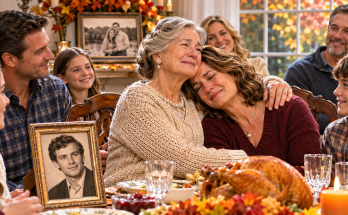
Linda quietly set the table using the porcelain dishes she had once removed without permission.
As dinner approached, I stood beside Harold’s grandfather clock.
Its familiar chimes echoed through the hallway.
Everything felt peaceful.
Not because every problem had disappeared.
Not because the past had been forgotten.
But because the life surrounding me was once again mine.
Before we began eating, Linda approached me.
“Mom?”
“Yes?”
She glanced around the dining room.
“I never understood how much this house meant to you.”
I looked toward Harold’s photograph.
“It isn’t just the house.”
She waited.
“It’s the freedom to decide where I wake up. What I eat. Who I invite into my home. How I spend the years I have left.”
She nodded slowly.
“I understand that now.”
“I hope you do.”
During dinner, my youngest grandson asked whether I would tell everyone a story about his grandfather.
I described how Harold had accidentally painted the porch the wrong color shortly after we purchased the house.
Everyone laughed.
Richard remembered the incident.
Susan added details I had forgotten.
Even Linda smiled.
For a moment, we were simply a family sharing memories.
After the guests departed, I stood alone beside the kitchen window.
Snow had begun falling across the garden.
I thought about the frightened woman who had sat in Room 217, watching photographs of strangers carrying away everything she loved.
My children had believed that growing older meant I was surrendering my authority over my own life.
They had mistaken my generosity for helplessness.
My trust for permission.
My love for an obligation.
They had been wrong.
Age had changed many things about me.
My hair was silver.
My hands were slower.
My knees complained whenever the weather turned cold.
But I was still Evelyn Parker.
I was still capable of making choices, setting boundaries, loving my family, and deciding how I wanted to live.
I turned off the kitchen light and walked toward the staircase.
Behind me, Harold’s grandfather clock began chiming.
I stopped to listen.
Then I smiled.
My children had once divided my belongings as though my story had already ended.
What they failed to understand was that I still had chapters left to write.
And every remaining chapter belonged to me.
THE END
Moral of the Story: Growing older does not mean surrendering your independence, dignity, or right to make decisions. An inheritance is a gift, not an entitlement. True love for aging parents is demonstrated through patience, respect, compassion, and gratitude