Part 1 of 3
At dawn, a neighbor found my little girl hiding behind a shed, shivering and barely able to stand. I was 4,000 miles away on deployment when the call came. When I finally returned, I didn’t start by confronting my husband. I went straight to the woman who had answered that call—and asked her to repeat those words to my face.
PART 1
My 9-year-old daughter called 911 while her uncle kicked in her bedroom door. She whispered our address four times, begging for help. The dispatcher replied, “Go back to bed, kid,” and hung up. The voice belonged to my own sister-in-law. At dawn, a neighbor found my little girl hiding behind a shed, shivering and barely able to stand. I was 4,000 miles away on deployment when the call came. When I finally returned, I didn’t start by confronting my husband. I went straight to the woman who had answered that call and asked her to repeat those words to my face.
My name is Joanna Whitaker, a Staff Sergeant in the U.S. Army. When deployment orders to the Middle East arrived, my world shattered: my husband, Russell, had just been paralyzed from the waist down in a commercial job-site fall, leaving our eight-year-old daughter, Poppy, vulnerable. In our most desperate hour, Russell’s older sister, Marlene, clutched my arms with tears in her eyes: “Go serve your country, Joanna. Blood takes care of blood. Wendell and I will protect this family as our own.”
God forgive me, but I believed her. Until the fateful night of October ninth.
Wendell, Marlene’s husband, used his spare key to enter our home under the pretext of printing an invoice. When Poppy padded down the hallway to retrieve a library book, she froze. Her uncle was forcibly prying open the locked family drawer, inserting a flash drive into the desktop. Glowing on the monitor was a private ledger under Russell’s name, marked with a figure highlighted in red: $38,600.00.
Caught red-handed, Wendell whirled around with predatory rage in his bloodshot eyes. Terrified, the little girl bolted down the corridor, slammed her bedroom door, and jammed the latch.
SLAM! A violent boot struck the timber, rattling the entire frame.
Two rooms away, Russell’s frantic shouts echoed in sheer agony. His wheelchair had been deliberately pushed twenty feet down the hallway hours earlier, leaving a disabled father helplessly trapped in his bed.
Under the dark shelter of her bed frame, Poppy’s trembling fingers dialed the only lifeline left: 9-1-1.
“Emergency dispatch, what is your location?”
“Please help me…” Poppy sobbed into the receiver. “My uncle is breaking down my door! He’s taking files from dad’s computer… I’m at 214 Maple Ridge Road!”
Disturbingly, the typing on the other end ceased. A chilling, deliberate silence hung in the frequency.
CRACK! The latch sheared off under another brutal kick, timber splintering across the carpet.
“214 Maple Ridge! Please hurry!” she screamed in terror.
No sirens tore through the night. Instead, the dispatcher’s voice returned, flat, dismissive, and venomously calm:
“Go back to bed, kid.”
Click. The line severed. The door yielded completely, framing Wendell’s menacing silhouette. With no protectors left, Poppy pulled the red emergency window latch and threw herself out into the freezing autumn mist…
Four thousand miles away in Kuwait, when an emergency transmission informed me that my child was hospitalized and Russell was found stranded on the floor, my blood turned to ice. But the darkest revelation was yet to come: The 911 dispatcher who had hung up on my terrified child… was Marlene herself.
What was that hidden $38,600 secret? And how far will a mother in uniform go when blood relatives become the ultimate threat?
PART 2
The fourteen-hour transatlantic flight aboard a C-17 felt endless. I sat motionless in my military uniform, staring into the darkness of the cargo bay. But nothing could drown out my daughter’s words echoing inside my head.
I’d spent eighteen years in the Army. I knew how to handle the most dangerous situations. But I’d never imagined that one day, the greatest threat would come from inside my own daughter’s bedroom.
When I arrived at Cape Fear Valley Medical Center, I didn’t stop by my unit or change out of my dust-covered uniform.
“Which room is Poppy Whitaker in?” I asked the nurse.
She glanced at my rank insignia before answering softly.
“Room 312, Sergeant. Please be gentle with her. She barely sleeps. She keeps staring at the door, waiting for her mother to come home.”
I opened the door.
Poppy looked impossibly small beneath the white hospital pillows. Her little leg was secured in a medical brace, and an IV line was attached to her hand. The moment she heard my voice, she turned sharply.
“Mom?”
That single word nearly brought me to my knees.
I opened my arms to hug her, but Poppy suddenly shrank back. I stopped immediately and knelt beside her bed.
“It’s okay, Peanut. Mommy’s home. You’re safe now.”
She stared at me for several seconds before bursting into tears and wrapping her little arms around my neck.
“He broke my bedroom door, Mommy! I called the police. I called so many times… but the lady on the phone told me to go to bed!”
I gently squeezed her hand.
“You did nothing wrong, sweetheart. Mommy believes you.”
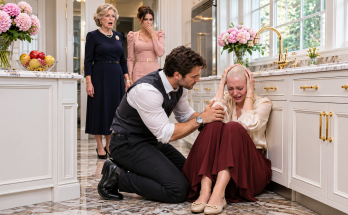
Forty minutes later, after Poppy had fallen asleep, I found Russell in the consultation room. He sat in his wheelchair, his face exhausted.
“Why was Wendell in our house at midnight?” I asked.
Russell lowered his head.
“He said he was helping me with the insurance claims. I signed a power of attorney for the medical accounts…”
“What about our savings?”
Russell began to cry.
“He said if I demanded to see the statements, he’d contact Child Protective Services. He threatened that a disabled father like me couldn’t take care of Poppy while you were overseas.”
Before I could respond, the door swung open.
Wendell stood there, holding an enormous teddy bear.
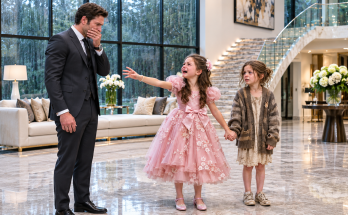
“Joanna! You’re finally home! I just wanted to bring the little girl a gift.”
“Get out.”
His smile stiffened.
“You think you can give me orders? I’ve been taking care of this family while you’ve been busy playing soldier!”
Just as two hospital security officers appeared, a gentle voice sounded behind me.
It was Ruthanne, our kindhearted neighbor.
She handed me a small plastic bag. Inside was a black flash drive, its casing cracked at one corner and streaked with wet grass.
Part 2 of 3
“I found it beneath the bushes right below Poppy’s bedroom window,” she whispered. “I believe this is what Wendell was looking for.”
PART 3
Wendell’s eyes went to the bag in my hand, and for one second the mask slipped completely. I saw arithmetic in his face, the kind a man does when he realizes how much he stands to lose.
“That’s mine,” he said. “That’s company property. I dropped it.”
“Out of an eight-year-old’s window,” I said. “At midnight.”
The security officers took him by the elbows. He went quietly, which told me more than a fight would have. Men who are sure they’ll win don’t go quietly.
I didn’t open the drive in that room. Eighteen years in the Army had taught me the difference between evidence and curiosity. I sealed the bag, signed across the flap, and asked Ruthanne to write down exactly where she’d found it and when. Then I called the Cumberland County Sheriff’s Office and asked for a detective, not a patrol deputy.
Detective Alana Pierce arrived within the hour. She was a compact woman in her forties with a legal pad and a habit of letting silence do her work. She listened to Russell. She listened to Ruthanne. Then she sat beside Poppy’s bed, in the chair I’d vacated, and asked my daughter a few gentle questions while Poppy held my hand with both of hers.
“You told the lady your address four times,” Pierce said. “Do you remember what she said before the last time?”
“She stopped typing,” Poppy whispered. “I could hear it stop.”
Pierce wrote that down. She didn’t look at me, but her pen pressed harder.
“Sergeant Whitaker, I’m going to be honest. If what your daughter says is accurate, the call was recorded. Every 911 call is. I’ll request the audio and the dispatch log tonight, before anyone has a reason to tidy them.”
“And my sister-in-law?”
“Until I’ve heard that recording, she’s a witness. After I’ve heard it, we’ll see.” She finally looked at me. “I know what you want to do. I’m asking you to let me do my job first.”
I nodded. It was one of the hardest nods of my life.
The drive opened on Pierce’s forensic laptop that night, in a conference room that smelled of burnt coffee. Russell had insisted on coming. We sat side by side, my hand on his shoulder, and watched the folders unfold.
The ledger was the first file. It matched the screen my daughter had seen: Russell’s name, a column of dates, and one red-highlighted figure, $38,600.00.
It wasn’t just a number. It was a trail.
Russell’s fall had triggered a workers’ compensation advance. His employer’s insurer had paid out in installments, and our church had run a fundraiser for his rehabilitation. The money from both had been routed, after Russell signed a power of attorney in a haze of pain medication, into an account Wendell controlled. Wendell ran a small trucking company, and the trucking company was drowning. For four months he had been feeding our family’s money into it, one transfer at a time, labeling each one as a medical expense.
The red figure was the shortfall. It was what Wendell would have to replace before the settlement’s final audit, scheduled for the middle of the month.
“He was going to be caught,” Pierce said quietly. “Nobody could look at that number without asking where it went.”
“So he came for the original,” I said. “The one on the family computer.”
“And the one in the drawer. Paper statements Russell kept.” She scrolled. “He wanted to wipe the trail and plant a version where Russell had made the withdrawals himself. A disabled man mismanaging his own funds. Then a call to Child Protective Services about unfit supervision, and suddenly the in-laws are the responsible adults.”
Russell’s hands had gone white on the armrests. “He said that to me, almost word for word. He said no one would believe a man in a wheelchair over a man with a business.”
“Somebody did,” I said, and I thought of Poppy’s small fingers on the red window latch.
The last folder on the drive was labeled M. It held a scanned notebook, ruled pages in handwriting I knew from every birthday card I’d ever received. Marlene’s.
Dates. Times. Shifts at the county communications center, where she’d worked as a dispatcher for eleven years. Beside each of Wendell’s visits to our house she had written a note.
10/9, W. at R’s, 10:40 p.m. Cover if anything pings. Wait for my text.
Pierce stopped breathing for a moment, then exhaled slowly. “She knew,” she said. “She knew he’d be there. She was on shift that night, waiting for something to ping.”
I stood up. I didn’t remember deciding to.
“Sergeant.”
“I’m not going to touch her.”
“I believe you. But I need you to understand what that notebook means. She sat at a console and heard a child scream for help from her brother’s house, and she knew exactly why.” Pierce’s voice was even, and underneath it was something fierce. “I’ll have the audio by morning. Don’t go to her tonight.”
I didn’t. I went back to the hospital and slept in a chair beside my daughter’s bed, with my boots on and my hand through the rail, holding hers.
The recording came at 7:40 a.m.
Pierce played it for us in the same conference room, with a victim advocate, a sheriff’s lieutenant, and a county prosecutor named Mr. Alvarado, who looked as if he hadn’t slept either.
It began with the dispatcher’s flat, professional greeting. “Emergency dispatch, what is your location?”
Then my daughter’s voice, tiny and shaking. My uncle is breaking down my door.
I had imagined that moment so many times on the flight, in the cargo bay, in the dark. Nothing I had imagined was as bad as the real sound of it. You could hear her breath hitching. You could hear wood splitting behind her.
The dispatcher said nothing for eleven seconds.
I counted them.
Then: 214 Maple Ridge! Please hurry!
And Marlene’s voice, steady as a metronome: “Go back to bed, kid.”
The click. Then the long tone of a dead line.
Mr. Alvarado took off his glasses and rubbed his eyes. “We can work with that,” he said, and I realized he meant it as the worst kind of compliment.
The audit logs were worse still. The computer-aided dispatch system showed that the call had been received, the location auto-populated from Poppy’s phone, and the entry closed by dispatcher M. Garrity, with the code for a prank call, within ninety seconds. No unit had been assigned. A second, delayed call, from Ruthanne, who had heard shouting and called at 5:50 a.m., was the only reason a deputy ever reached our street.
By then my daughter had been outside in forty-degree mist for hours, barefoot, hiding behind a shed with a broken ankle, and Russell had been on the floor of our bedroom, unable to reach a phone.
I asked Pierce one question. “Can I talk to her? With you there?”
She studied me for a long moment.
“On the record,” she said. “Wearing a wire. You say nothing that isn’t true and nothing that’s a threat. If she talks, she talks. If she doesn’t, you walk away.”
“That’s all I need.”
Marlene opened her front door in a pink bathrobe with a cup of tea in her hand. She’d already had one night to think. Her eyes were red, her hair was neatly pinned, and her expression arranged itself into relief when she saw me.
“Joanna. Thank God. I’ve been sick about Poppy. I was going to come to the hospital.”
“Were you?”
Part 3 of 3
“Of course.” She stepped back. “Come in. Honey, you look exhausted.”
I stayed on the porch. Pierce and a deputy waited in an unmarked car across the street, close enough to hear every word.
“I read the file this morning,” I said. “I want to ask you something, Marlene. I want you to repeat what you said to my daughter.”
“I don’t know what you mean.”
“You told her to go back to bed.”
Her face did a very small thing. A flicker, no more. “Joanna, I don’t have any idea—”
“October ninth. Ten forty-one p.m. The call came in on your console. She was nine years old. She told you her name. She told you her address four times.” I kept my voice level, because if it rose I knew I wouldn’t be able to stop it. “I’m not asking you to explain. I’m asking you to say it to my face. Say it the way you said it to her.”
She set the cup down on the porch rail. Her hand was steady, which frightened me more than shaking would have.
“You’ve been away,” she said. “You don’t know what it’s been like. Russell can barely take care of himself. Wendell has been under so much stress, and we’ve been carrying all of you, and the business—” She stopped. “He told me he was only getting some papers. He told me Poppy was fine.”
“You wrote it in a notebook.”
“What notebook?”
“‘Cover if anything pings. Wait for my text.’”
For the first time she looked at me, really looked, and I watched her work out that I knew more than she’d planned for.
“I didn’t think she’d call,” Marlene said at last, very quietly. “She wasn’t supposed to be awake.”
“And when she did?”
She didn’t answer. Her mouth worked, and her eyes filled, and for a second I thought she might say the thing I’d flown four thousand miles to hear.
Then the practiced softness crept back. “Joanna, I did what I had to do to protect this family.”
“Say it,” I said. “What you told her.”
She stared at me. Behind me, Pierce’s car door opened.
“Go back to bed, kid,” Marlene said, in a small, cold, exact voice. And the instant it left her lips, she knew what she’d done.
“Marlene Garrity,” Pierce said from the bottom of the steps, “I need you to put your hands where I can see them.”
Wendell was arrested that afternoon at his trucking yard, with two hundred pages of falsified invoices in the passenger seat of his truck. The charges stacked up the way charges do: breaking and entering, misappropriation of funds belonging to a vulnerable adult, felony exploitation of a disabled person, assault, and child endangerment. The forged documents added fraud. Marlene faced her own list: obstruction, misuse of a public safety system, and the charge Mr. Alvarado said he’d never had to write before, willful neglect of an emergency call resulting in serious injury to a child.
She did not look at me in court. She looked at her hands.
Wendell took a plea in January. He was sentenced to nine years, with full restitution ordered against the assets of his business and the home he and Marlene shared. Marlene was convicted by a judge after a short bench trial, because her lawyer could not find anyone willing to argue with the recording. The sentence was less than Wendell’s, and more than she believed she deserved, because she believed she had deserved nothing.
I did not attend the sentencing for her. I’d said what I came to say, on a porch, in the morning light.
The county reviewed every call she had handled that year. Three more had been closed without dispatch. None had ended in tragedy, by luck, not by design. The communications center installed a second-supervisor review for every call coded as a prank, and it named the policy after a girl it never mentioned by name.
Poppy’s ankle healed by Christmas.
The harder healing took longer. For months she slept with the closet light on and her door propped open by a heavy boot. She wouldn’t use the phone. Once, in the grocery store, a woman’s voice on the overhead speaker said something ordinary, and my daughter went rigid and silent in the cart.
I took emergency leave, then a hardship reassignment, and then I did something I’d never imagined: I put in my retirement papers. Eighteen years. I was proud of every one of them. I would have given every one back for the night I wasn’t there.
The Army did what the Army does, which is to give you more than it owes you and ask for nothing in return. My commander called me the day the papers went through. “Staff Sergeant,” he said, “you finished your job. Go finish this one.”
Russell and I sat across from each other that winter and said the things we hadn’t said. He’d been ashamed, afraid, and drugged, and he’d trusted his sister because trust was all he had left. I’d gone because I believed in duty, and because I believed in blood. We cried at the kitchen table, two people who had each failed in different directions. Then we got to work.
We put in a ramp. We lowered the counters. We replaced every lock, and Ruthanne, who’d spent her career as a school bus driver and wasn’t afraid of anybody, brought over a spare key and a casserole and said, “Next time, you give this one to me.” Poppy’s new bedroom door was solid oak, painted yellow, with a latch that opened from either side.
“So nobody can lock me in,” she explained to the contractor, very seriously, “and nobody can lock them out, if they’re the good ones.”
On a bright morning in the spring, Poppy asked me to take her to a place she’d been thinking about.
It was the county communications center, a low brick building off a state road. Detective Pierce met us in the lobby, and so did the new director, a man named Hollis who shook my hand with both of his and didn’t try to say anything clever.
A young dispatcher named Kendra, barely twenty-five, showed us her console. A big monitor. A headset. A small plaque on the wall that read, in plain black letters: Every call is a child at the other end.
Poppy stood very still. Then she climbed onto the stool and put the headset on, awkwardly, over her ears.
“What would you say,” she asked Kendra, “if somebody called and said they were scared?”
“I’d say, ‘I’m here. Tell me where you are.’”
“What if they were whispering?”
“I’d listen harder.”
Poppy nodded slowly. She was nine years old by then, taller, her hair longer, her leg strong. She took off the headset and set it gently on the console, as if it were something that deserved care.
“Okay,” she said. “That’s right.”
On the drive home she was quiet. At a red light, she looked out the window at a flag fluttering in front of a post office.
“Mom?”
“Yeah, Peanut.”
“I’m glad you came home first.”
“Home first?”
“Before you did anything else. You went to see me.” She turned back to me. “You didn’t start with being mad.”
I swallowed. I’d never told her about the porch. I never would, not until she was old enough to hear it.
“I started with you,” I said. “Always.”
The light turned green. I drove through it slowly, with both hands on the wheel, past the post office and the flag, toward a house with a yellow door and a front window where a man in a wheelchair, who had learned to wave with his whole arm, was already waiting.
THE END.