Part 1 of 3
Fifteen minutes later, my sister’s husband, a highly decorated Navy SEAL, entered the banquet hall. My mother hurried toward him, proudly announcing, “Now, here’s our real hero!” But he barely acknowledged her. Instead, he approached my table, stood before me, and delivered a flawless military salute. “Ma’am,” he said firmly. The entire room fell silent.
PART 1
The moment I entered the magnificent banquet hall, holding my newborn daughter close to my chest, my mother stepped directly into my path.
“Just ensure you don’t humiliate us tonight,” she hissed, her voice dripping with disdain. “This family already has enough freeloaders.”
Her words hurt, but I didn’t allow my expression to change.
Before I could respond, my younger brother Dillon walked past us in his tactical police uniform.
He looked me over and gave a contemptuous snort.
“Look who crawled out of her cubicle. The government leech has arrived.”
Only a few feet away stood my father, a retired military officer.
He heard everything.
Yet rather than defend me or challenge Dillon’s insult, he deliberately turned his back.
To him, I might as well have been invisible.
What none of them understood was how much I’d quietly sacrificed for this family.
For more than ten years, I’d used my own savings to pay their debts and resolve the financial problems they repeatedly created.
I’d never demanded gratitude or recognition.
My work was governed by strict, top-secret nondisclosure agreements, preventing me from explaining the nature of my responsibilities.
Because I couldn’t discuss my career, my relatives assumed I held an insignificant government office position.
They called me a glorified secretary.
They believed I’d accomplished nothing important.
They had no idea what I’d actually been doing inside those freezing, windowless intelligence facilities just three weeks earlier.
I forced a small smile, adjusted my newborn daughter in my arms, and walked away from the entrance.
I found a secluded table in a dim corner of the banquet hall and sat down quietly.
There was no reason to argue.
Fifteen minutes passed.
Then the heavy brass doors opened.
My sister’s husband entered.
He was the evening’s guest of honor, a highly decorated Navy SEAL whose military achievements had earned him considerable admiration.
My mother’s expression transformed immediately.
She hurried toward him, smiling with unmistakable pride.
“Now, here is the real hero of our family!”
But he barely acknowledged her enthusiastic welcome.
Instead, his eyes moved across the crowded banquet hall.
He scanned the guests until his gaze settled on the shadowed corner where I sat with my daughter.
Then he began walking directly toward me.
The wealthy guests watched in confusion as he passed them without stopping.
He ignored my mother’s attempts to command his attention.
His footsteps carried him across the hall until he reached my table.
He stopped only inches away.
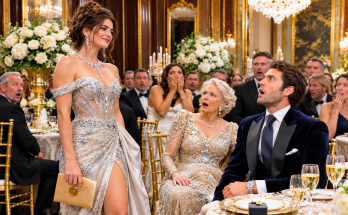
Then he brought his heels together, straightened his posture, and raised his hand in a sharp, perfectly executed military salute.
“Ma’am,” he stated firmly, his commanding voice echoing through the sudden silence.
My mother’s proud smile froze.
Dillon’s mocking expression disappeared.
My father turned back toward us.
Every relative who had laughed at me moments earlier stared in disbelief.
And as they watched the decorated Navy SEAL standing at attention before me, they began to realize that the woman they’d dismissed as a failure was someone they had never truly known…
PART 2: The Salute
Lieutenant Commander Cole Brennan had walked into that hall in his Navy dress whites. The gold trident on his chest caught the chandelier light. The room had gone quiet for him, ready to cheer.
My mother, Judith, had her arms half raised for a hug. My father, Harlan, had pulled in his stomach and squared his shoulders like he was back on the parade ground. By the bar, my sister Camille smiled and waved, her diamond ring sparkling.
Cole didn’t look at any of them.
He didn’t stroll over, either. He marched. Every step was straight and sharp, and the crowd moved out of his way without being asked.
Part 2 of 3
Judith’s arms dropped. Harlan blinked fast. Dillon stopped with his drink halfway to his mouth.
I stayed in my chair. I kept my hands flat on the white tablecloth and watched him come.
Now you know how it ended. Cole stopped three paces from my table. His heels clicked together like a gunshot. He said, “Ma’am,” and he saluted.
It was a perfect salute. Fingers straight, hand at his brow, held steady. It was the kind of respect a junior officer gives only to a superior, never to a civilian and never to a secretary.
My aunt dropped her fork onto her plate with an ugly clatter. Dillon’s hand shook so hard that bourbon sloshed over the rim and stained his uniform shirt.
My father’s mouth fell open. He had spent his life in the Marines. He knew exactly what that salute meant.
I didn’t smile or gloat. I let the silence stay heavy and let the truth do its work.
My phone buzzed on the table. It was a text from my husband, Rhys, with a photo of our daughter Wynne fast asleep against his chest in our car. A warm, fierce feeling filled me. That’s my real family, I thought. The people in this room are only ghosts.
I stood up slowly. Years of command took over. I put my shoulders back, kept my face calm, and returned the salute.
“Lieutenant Commander Brennan,” I said.
I lowered my hand. Cole held his a second longer, a last show of respect, and then dropped it.
Across the room, my father had turned a sick gray. My mother gripped a cocktail table as every guest in the hall stared at her, waiting for an explanation she didn’t have.
Cole leaned in and spoke so only I could hear. “I didn’t know if you’d be here, Colonel.” He nodded at the empty chair beside me. “May I?”
I gave a single nod. He pulled out the chair and sat down next to the “freeloader.”
It took one minute for the room to crack. Camille rushed over in her high heels, her face stiff with panic.
“You’re here,” she said, with a fake smile.
“Of course,” Cole said. He didn’t stand. A gentleman usually stands when his wife walks up, but Cole stayed seated beside his superior officer. That wasn’t an insult to Camille. It was protocol.
Dillon stomped over next, red-faced, smelling of bourbon. “What kind of joke is this, Cole?” He jabbed a finger at me. “She’s a glorified secretary!”
Cole turned his head. He didn’t raise his voice, but the look in his eyes made Dillon take a step back.
“You have no idea what this woman does,” Cole said, low and hard. “She holds the lives of men like me in her hands. Without her intel, my team would have come home in boxes. Disrespect the Colonel again in front of me, and I’ll take you outside and teach you some manners.”
Dillon’s jaw snapped shut. He looked at our father for help, but Harlan only stared at the floor.
I didn’t stay for cake. I picked up my phone, smoothed my shirt, and walked toward the door. The crowd stepped aside. My parents shrank back as I passed.
Outside, the night air was cool. I crossed the lot to our black sedan. Rhys got out and held the door. I slid into the back seat and breathed in the soft smell of baby powder and warm milk.
“How was the party?” he asked gently.
“Over,” I whispered, and I lifted Wynne into my arms.
I pressed my cheek to her warm head, and for the first time all night, my shoulders relaxed. The banquet hall shrank into a smear of gold in the rear window.
Before we reached the highway, my phone buzzed again. It was an unknown number, with one line of text.
Colonel, we need to talk. Your father has made a call he should never have made.
PART 3: The Quiet Empire
The text came from Major Dana Whitcomb, my security officer. She called me back before we got home.
“Ma’am, your father phoned an old Marine buddy this afternoon, a retired colonel who now works as a contractor at the Pentagon. He asked what your job really was. He said, and I quote, ‘My daughter has been lying to us about her career.’”
I closed my eyes. “What did the contractor say?”
“Nothing, ma’am. He knew better. But he reported the call, as he should. It triggered a routine review.”
“So I’m under investigation because my father is nosy.”
“No, ma’am. You’re fine. It’s only a formality. But your father may get a letter reminding him that asking about classified work is serious.”
I almost laughed. My father had spent forty years believing rank was the only thing that mattered. And the first time he used his old connections, they sent him a warning.
I decided right then that I was done explaining myself. I went completely silent. No calls, no texts, no visits. I treated my personal life like my secure networks. Zero access.
They did not take it well. First came a voicemail from Judith, in the sugary voice she used on local politicians. “Tamsin, honey, things got a little tense. We should all sit down for dinner. We’re family, after all.” I deleted it.
Then a thick envelope arrived with old photos from my middle school science fair and a sticky note: You were always the genius. I fed the whole thing into the shredder in Rhys’s office and watched my childhood curl into confetti.
Dillon posted a photo of himself in his SWAT gear with the caption: Some people hide behind fancy government titles. Real men put on the gear and serve their community.
I didn’t get angry. I felt a calm sort of pity. I blocked him and moved on.
My real life, meanwhile, was growing. Rhys and I lived in a quiet, well-guarded house outside the city. He ran his shipping company from a tablet in the evenings while I nursed Wynne. He understood the weight of my work, because he carried the weight of his own. We were two people who didn’t need to prove anything to anybody.
A month after the banquet, a handwritten letter arrived from Camille.
I’m sorry, it said. I chased money and appearances, and I let them treat you like garbage because it made me look better. I was a coward. You had a baby, and I wasn’t there. I don’t expect forgiveness. I just needed to say it.
I read it by the nursery window while Rhys rocked Wynne to sleep. The paper was warped in a few places, as if something had dripped on it and dried. She had cried while she wrote.
I read it three times. It was the first honest thing anyone in my family had given me in twenty years.
I unblocked her number and called. She answered on the first ring.
“I’m listening,” I said.
“Tamsin, I just want to—”
“No tears. Here’s how this works. If they insult me, you don’t stay quiet. You don’t carry messages from Mom or Dad. And you never use my daughter to try to force a reunion. Break one of those rules, and the line goes dead for good.”
Part 3 of 3
“Okay,” she whispered. “I understand.”
I didn’t offer love. I didn’t offer forgiveness. I only gave her terms, and I hung up. Rhys looked up from the rocking chair, and he didn’t ask. He just held out his hand, and I crossed the room and took it.
Two months later, I took over a new post at a joint cyber command. My promotion appeared on military networks, and congratulations poured in from generals and directors. From my parents and Dillon, there was only silence.
Then, on a gray Tuesday, I was ordered to Washington, D.C. I was to give the main briefing at a joint congressional hearing on cyber threats. Rhys drove me to the airfield, kissed my temple, and held Wynne up to the car window until the engines drowned everything out.
In the holding room, I smoothed my Army service uniform and straightened the silver oak leaf on my collar. I rehearsed the first three lines of my briefing twice. My hands were steady. They had always been steady. It was the one thing my family could never take from me.
I walked into the big, echoing hearing room and stepped up to the podium. In the front rows sat generals and admirals, pens ready. I did my usual sweep of the room. The light from the tall windows fell in pale bars across the carpet. When my eyes reached the civilian gallery above, the blood in my veins went cold.
In the second row, holding cheap plastic visitor badges, sat my parents.
Judith’s lips were pressed into a thin line. Harlan gripped the railing like the whole gallery was tilting. They didn’t look proud. They looked like people who had come with a plan and only now realized how far from home they were.
The chairman nodded for me to begin. Every head in the hall turned toward me. And in the gallery above, my mother stood up, pointed straight at me, and opened her mouth to shout.
“That’s my daughter! She’s been lying to us for years! She owes this family—”
Two security officers were at her side before she finished the sentence. They spoke to her quietly, took her elbow, and walked her toward the exit. My father followed behind them without a word, his face the color of ash.
The chairman cleared his throat. “Colonel, whenever you’re ready.”
“Thank you, sir,” I said.
Then I began. I didn’t pause or look up at the gallery again. A three-star general in the front row gave me a small nod of respect. My voice didn’t shake. I briefed them for an hour, and when I finished, the hall stood and applauded.
When the room had emptied, I stood by a side door packing classified papers into my briefcase. Behind me, I heard slow, dragging footsteps on the marble floor.
I didn’t turn right away. I let him wait.
When I finally faced him, my father stood a few feet away. He didn’t look like the stern retired officer I had known. His shoulders sagged, and he looked small, like an old man standing at the foot of a mountain he finally understood he could never climb.
He didn’t reach out to hug me. He couldn’t even offer his hand. He swallowed hard.
“You looked like a real commander up there,” he said, his voice cracking. “Your mother and I… we just didn’t know.”
I didn’t smile. I didn’t tell him it was all right.
“I know,” I said. “That was your short-sightedness. Not mine.”
“Tamsin, I made that call because I wanted to understand. I should have asked you. I should have asked years ago.”
“You should have,” I said. “You had a thousand chances. You turned your back every time.”
His eyes filled. “I’m sorry.”
It was the first time I had ever heard him say it. I let it sit in the air between us.
“I’m not ready to forgive you,” I said. “If you want to be in my daughter’s life, you start by being a different man. Slowly. And you start by apologizing to Mom and Dillon for lying to themselves, too. I can’t do that part for you.”
He nodded. For the first time in his life, Harlan Pike lowered his head and stepped aside to clear my path.
I walked down the long Pentagon hallway, my heels clicking on the floor. I didn’t look back.
Outside, the air was cold and sharp. Rhys’s black sedan sat at the curb with its engine running. He stepped out in a dark suit, met my eyes, and opened the back door.
Wynne was awake in her car seat, stretching her little hands toward me and babbling. All the pressure of the day, and all the years of trying to earn love from people who never offered it, melted away the second my fingers touched her cheek.
ONE YEAR LATER
I never got the big, dramatic reunion my mother had probably pictured. What I got was slower, and better.
My father wrote me a letter every month. They were short and plain. He never asked for anything. He told me what he’d been reading, what he was learning, and how he was trying to change. After six months, I let him visit. He held Wynne with shaking hands and cried.
My mother took longer. She arrived at my door one afternoon with no makeup and no pearls. She didn’t make excuses. She said, “I was jealous of you, Tamsin. You never needed me to tell you what you were worth.” I told her I was glad she finally said it. We started with one lunch, and it was awkward and quiet, and it was a start.
Dillon never did apologize. Last I heard, he was still posting about “real men.” That was fine. Not every door has to open.
Camille kept every rule. She showed up for Wynne’s first birthday with a stuffed rabbit and sat quietly in the corner until I waved her over. Cole came too, in a plain shirt and jeans, and he held Wynne on his lap and made her laugh so hard she got the hiccups.
“Colonel,” he said, with a grin.
“Not today,” I said. “Today I’m just Wynne’s mom.”
That evening, after everyone had gone, I stood in the kitchen with Rhys, washing cake plates. The kitchen window was open, and the autumn air smelled like leaves. Wynne slept upstairs.
“Do you ever think about that night?” he asked. “The banquet.”
“Sometimes.”
“What do you think about?”
I rinsed a plate and thought about it.
“I think about how hard I worked for them to see me,” I said. “And how it never mattered. The day I stopped needing them to, everything changed.”
He dried his hands and pulled me against his chest. “You know what I think?”
“What?”
“That you were always the commander,” Rhys said. “You just needed the right room to see it.”
I leaned into him, and the house was quiet and warm around us.
Justice doesn’t always need a raised voice. It doesn’t need broken plates or begging for apologies from people who can’t understand your worth. Sometimes it’s just the click of two heels, one respectful word, and the peace of walking away to build a life that belongs entirely to you.
THE END.