PART 1
My name is Warren. I’m seventy years old. I’m a retired mail carrier, and I live alone on a few acres outside Lancaster, Pennsylvania.
My wife passed four years ago. Since then, it’s just been me and the quiet. I have a bad heart. Two stents. A bottle of nitroglycerin pills in my pocket at all times.
My neighbor is Burt. He raises pigs for a meat company. Two hundred of them, in long metal barns that smell for a mile.
In September, a truck from Burt’s farm was driving down our road to the processing plant. It hit a pothole. The back gate rattled open.
One pig jumped out.
She was small for a pig. Pink with black spots. One ear flopped over. She ran straight into the cornfield behind my house and disappeared.
The truck never stopped.
That night, I heard something rooting around by my garbage cans. I went out with a flashlight.
There she was. Shaking. Scared. A cut on her leg from the jump.
She looked up at me with these small, smart eyes.
I don’t know why I did it. I’d eaten bacon my whole life.
But I opened the door to my empty barn and put down a bucket of water and some apples.
She walked right in.
I named her Dolly.
Every morning after that, I fed her. Apples. Corn. Leftover bread. I cleaned the cut on her leg. I sat on an overturned bucket and talked to her about my wife, about the weather, about nothing.
She followed me around like a dog. She learned her name in three days. She learned to sit for an apple in a week. When I came into the barn every morning, she’d squeal and spin in a circle.
She was the best company I’d had in four years.
On the fortieth day, Burt showed up at my door.
He’s a big man in his fifties. Red face. Always angry.
“Warren,” he said, “one of my drivers says he saw a spotted pig in your yard. I’m missing one from the September load.”
I didn’t lie to him.
“She jumped off your truck. She was hurt. I took care of her.”
“That’s my pig. I’m taking her.”
“Burt, I’ll buy her from you. What’s she worth?”
He laughed.
“She’s not for sale. She’s property. And you’ve been hiding stolen property for over a month.” He pointed his finger at my chest. “I’m coming back Sunday with my trailer. That pig goes to the plant. Bacon by Sunday. And if you give me any trouble, I’ll call the sheriff and have you charged with theft. You’ll pay me for every day you hid her.”
Then he walked off my porch.
That night, I sat in the barn with Dolly for a long time. She put her head in my lap.
I didn’t sleep. I didn’t argue anymore. I just said to her, very quietly, “Okay. We’ll figure it out.”
The next morning was day forty-one.
I was standing in my kitchen, making coffee, when a pain hit my chest like a hammer.
I couldn’t breathe. My left arm went numb. The coffee pot fell out of my hand and shattered on the floor.
I reached for my pill bottle in my pocket. My fingers wouldn’t work. It fell and rolled under the stove.
I fell down next to it.
My phone was on the kitchen table. Six feet away. It might as well have been six miles.
I tried to crawl. I couldn’t.
I don’t know how long I lay there. Ten minutes. Maybe more.
Then I heard a loud squeal at the back door.
Dolly.
She’d pushed open the barn door. She was standing outside the kitchen, looking at me through the screen.
She squealed again. Then she pushed the screen door open with her nose and trotted over to me. She sniffed my face. She nudged my cheek.
“Good girl,” I whispered. “Go. Get help.”
I don’t know if she understood.
Part 2 of 3
But she turned around and ran out the door.
Straight down my driveway.
And out onto the road.
The last thing I saw, before everything went dark, was a little spotted pig running toward the highway, where the cars go sixty miles an hour.
PART 2
I pieced together what happened next from the people who were there.
A young nurse named Brianna Kowalski was driving to her morning shift at Lancaster General. At 7:20, she came around the bend on Route 30, still half-asleep, her coffee going cold in the cup holder.
A spotted pig was lying in the middle of her lane.
Not running. Not wandering. Lying flat on the asphalt, right in the path of anything that came around that curve.
Brianna stood on the brakes. Her tires shrieked, and her car stopped about ten feet short.
She honked. The pig didn’t move.
She got out, heart pounding, and waved her arms. “Hey, piggy. You’ve got to get out of the road.”
The pig stood up. She trotted a few steps toward a gravel driveway. Then she stopped and looked back over her shoulder.
She squealed.
Brianna didn’t move. The pig trotted a few more steps and looked back again. Squealed again, louder, like she was losing patience.
“I know how this sounds,” Brianna told the newspaper later. “But she was asking me to follow her. Like those dogs in old movies. I honestly thought I’d lost my mind.”
She followed anyway. Up my driveway, past the barn with its door swung wide open, to my back door, which stood ajar.
And there I was, gray-faced on the kitchen floor in a puddle of cold coffee.
Brianna worked cardiac care. Eleven years of it. She dropped to her knees, found no pulse worth the name, and shouted for 911 on speaker while her hands were already moving. She dug my pill bottle out from under the stove. She started compressions.
My heart stopped twice before the ambulance reached the house. Twice she brought me back, on the linoleum, with a pig standing three feet away, watching.
“She never left,” Brianna said. “She stood right there the entire time. When the paramedics came through the door, she backed up to the wall to give them room. Like she knew.”
I woke up in the hospital two days later, with tubes in both arms and a new stent in my chest. A woman I didn’t recognize stood at the foot of my bed in scrubs.
“Mr. Warren? I’m Brianna. I’m the one who found you.” She smiled. “Well. Your pig found me.”
I started laughing. It hurt like fire. I didn’t care.
“Where is she? Where’s Dolly?”
The smile slipped.
“Your neighbor came by the house while the paramedics were loading you up. He had a trailer.”
My stomach turned over.
“What day is it?”
“Sunday.”
I closed my eyes. Forty-one days of apples and bad jokes and a spinning pig in a barn doorway, and I’d lost her anyway, because my heart couldn’t wait until Monday.
I lay there a long time. Brianna sat down beside me and didn’t say anything, which was the kindest thing she could have done.
Around four that afternoon, someone knocked on the door frame.
Burt stood there with his cap crushed in both hands. He looked ten years older than he had on my porch. His face was less red and more gray, and his eyes were swollen.
“Warren.”
I couldn’t think of one thing to say.
He came in slowly and lowered himself into the visitor’s chair like it might break under him.
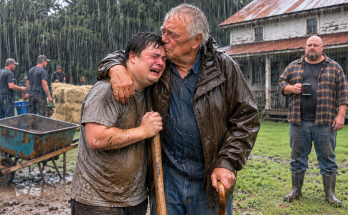
“That nurse found me in the parking lot this morning,” he said. “She told me everything. About Route 30. About the pig lying down in the road.” He rubbed his jaw. “I’ve been raising hogs thirty-one years. I’ve loaded about forty thousand of them onto trucks. I never once thought of them as….”
He stopped.
“I stood in your barn at six o’clock this morning with a rope in my hand,” he said. “And she looked at me. She wasn’t scared, Warren. That’s what got me. She looked at me like she was waiting to see what kind of man I was going to be.”
My throat tightened.
“I didn’t load her,” he said. “I couldn’t.”
He reached into his jacket and pulled out a folded sheet of paper. His hands weren’t steady.
“Bill of sale. One spotted sow, sold to Warren Hadley for one dollar.” He set it on my blanket. “I already put the dollar in the till myself. She’s yours. She’s been yours since the day she jumped off my truck, I just didn’t have the sense to see it.”
I picked up the paper. The ink blurred.
Part 3 of 3
“And I’m sorry,” Burt said quietly. “For what I said on your porch. About the sheriff, and the days, and the bacon. You didn’t deserve that. You were a better neighbor to that animal than I’ve been to anybody in a long time.”
“Where is she now?”
“Back in your barn. I fed her this morning. Gave her some of those apples out of your cellar.” He cleared his throat. “She wouldn’t eat until I told her you were alive.”
I laughed and cried at the same time, and I didn’t feel one bit ashamed of either.
PART 3
They let me go home eight days later.
Brianna drove me. She’d offered, and I’d stopped arguing with her by the second day, because I could tell it was a waste of breath. She carried my bag up the steps and made me sit in the kitchen while she checked my blood pressure, my pills, my pulse, and the refrigerator.
“Mr. Warren, there’s nothing in here but pickles and half a stick of butter.”
“I live alone.”
“Not anymore,” she said, and she nodded toward the window.
Out in the yard stood Dolly, at the barn door, ears pricked, staring at the house. The second my face appeared in the glass, she let out a squeal that rattled the panes and began to spin in circles so fast she nearly fell over.
I made it out to the barn without my cane. Dr. Patel would have had my hide. I didn’t care. Dolly shoved her whole warm snout into my stomach and leaned there, grunting, and I stood in the straw with my hands in her bristly shoulders and cried like a child.
“Okay, girl,” I said. “Okay. I’m here. I’m here.”
The newspaper ran the story that Thursday. A reporter named Gladys Finch drove out with a photographer and spent three hours at my kitchen table. The headline said PIG SAVES RETIRED MAILMAN, and the photo showed Dolly sitting at my feet, ears flopped, looking dignified.
By Saturday, cars were lining my road.
People came from Ohio and Maryland and one family all the way from Vermont. They stood at my fence and took pictures. Kids fed her apples through the boards. A woman in a church dress held a toddler up to scratch behind that crooked ear, and Dolly allowed it, with the patience of a queen.
I put out a coffee can with a sign. Apples for Dolly. By the end of the month it was a barrel.
One morning in November, Burt’s pickup crawled to a stop at my fence.
I’d seen him a few times since the hospital. A nod at the mailbox. A wave over the hedge. We hadn’t really talked.
He climbed out with a bucket of cracked corn and set it on the ground like he wasn’t sure he was allowed to come any closer.
“For the hero,” he muttered.
“She’ll eat every kernel,” I said.
He stood there with his hands in his pockets. The cold made his breath puff white.
“Warren, I did something.”
“What’s that?”
“I called the company yesterday.” He stared at the ground. “I told them I’m cutting my herd. Not all at once. I can’t, I’ve got a mortgage and a son at Penn State. But I’m converting half the barns. Going to try pasture-raised. Smaller. Slower.” He shrugged, awkward. “It won’t pay as well.”
“Why?”
He looked at Dolly for a long moment. She’d wandered over and was leaning her whole weight against the fence post, eyes half-closed.
“Because I stood in that barn,” he said, “and I couldn’t do it. And if I couldn’t do it to one, I don’t know how I’ve been doing it to two hundred.”
I didn’t say anything. There wasn’t a thing to say that he hadn’t already said better himself.
He opened the gate, slow, and stepped into my yard. He crouched, grunting, and held out one hand toward Dolly.
She sniffed it. Then she pushed her head under his palm.
He scratched behind that floppy ear for twenty minutes.
I watched from the porch, sipping coffee, and pretended I wasn’t looking. He never knew I saw it, the way his rough old face went soft and wet and almost young.
It’s been two years now.
Dolly weighs three hundred pounds. She has her own heated corner in the barn, with a quilt my wife knitted forty years ago and a mound of fresh hay that Burt’s son delivers every other Saturday, free, over my protests.
Brianna still comes every Sunday. She says it’s to check my blood pressure, but she stays for supper, and sometimes she brings her fiancé, a quiet carpenter who built Dolly a covered porch for the rainy days. My heart’s held steady. Dr. Patel says I’m the most boring patient he has, and he means it as a compliment.
Every morning, I take my coffee out to the barn.
And every morning, before I’ve even reached the latch, I hear it. That squeal. Then the sound of hooves scrambling in the straw.
I open the door, and Dolly spins in a circle.
I sit down on my overturned bucket. She rests her enormous head in my lap. And I tell her about the weather, about nothing, about my wife, who I think would have liked her.
The quiet in this house doesn’t feel like quiet anymore.
It feels like company.
THE END.